You stand on the edge of a jagged cliff. The salt spray hits your face. Below you, the Atlantic Ocean crashes with a power that feels ancient. This is not just a vacation. It is a journey into the soul of two nations. If you seek the best scotland and ireland itinerary, you have come to the right place.
First of all, you must prepare for the magic of 2026. The mist on the Scottish lochs and the green fields of the Emerald Isle wait for you. You deserve a trip that balances history with comfort. You want stories of kings and a pint with locals. This guide provides exactly that. Plus, it uses the wisdom of people who have walked these paths before.
Why You Should Choose a 14-Day Adventure
A common question travelers ask is about time. You might look at a scotland and ireland itinerary 7 days or even a scotland and ireland itinerary 10 days. However, those shorter trips often feel like a race. You spend more time on a bus than on the grass. Therefore, a scotland and ireland itinerary 14 days is the gold standard.
On top of that, two weeks allow you to see both the cities and the wild spaces. You can visit the Scottish Highlands and the Wild Atlantic Way without exhaustion. Gradually, you will realize that these countries share a Gaelic heart but have very different souls.
The Perfect Time to Pack Your Bags
First of all, you must decide when to go. Statistics show that the best time is the spring or early fall. April and May are often the driest months in Ireland. At that time, wildflowers bloom across the hills. Early September is also wonderful. The summer crowds dissipate, but the weather remains pleasant.
Additionally, temperature averages stay around 55°F (13°C). You might see warmer highs in September. This makes it perfect for long walks. You will need a jacket, of course. Ireland has a mild climate, but it is famous for rain. That rain is why the grass is so green. On top of that, the daylight is a factor. In the summer, you get light until 10:00 PM or even 11:00 PM. Later, in December, the sun sets as early as 3:44 PM in places like Glasgow. Therefore, you should aim for the long days of 2026.
What to Put in Your Suitcase
You do not need a mountain of luggage. You need layers. First of all, bring great denim and sweaters. A hooded rain jacket is non-negotiable. Plus, you should pack at least four pairs of shoes if you have the space: white sneakers, rain boots, Chelsea boots, and hiking boots.
Similarly, you must remember the power adapter. You will need one for the three-pin plugs used there. Additionally, bring a reusable battery for your phone. You will take hundreds of photos. Therefore, do not let a dead battery ruin your visit to a 12th-century castle.
Your Journey Begins: The Scottish Leg
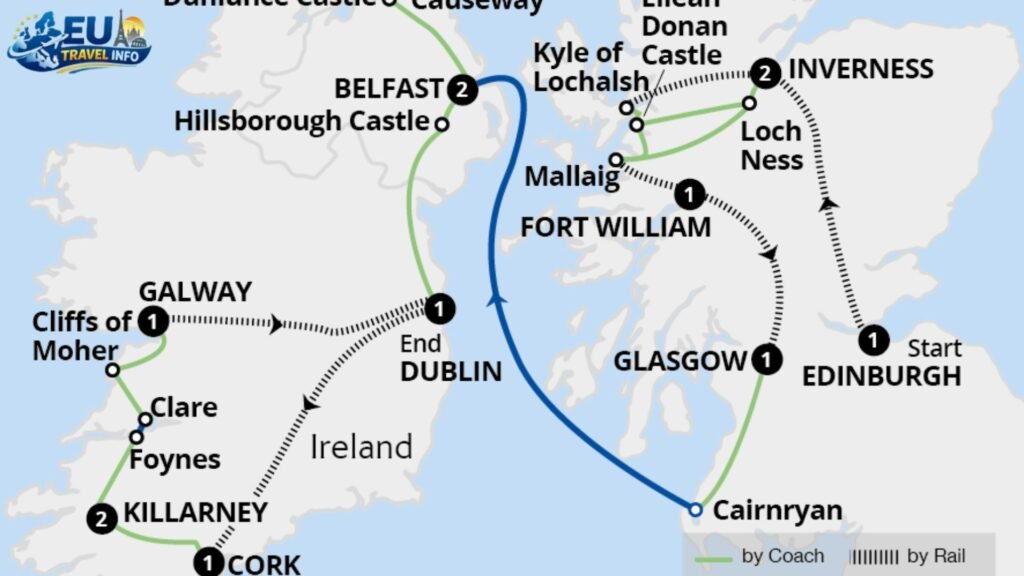
Day 1: The Capital of Culture
You arrive at Edinburgh Airport. Your journey starts with a smooth transfer to your hotel. Edinburgh is the cultural hub of Scotland. It is a city built on top of old volcanoes. Gradually, you settle in. This afternoon, you take a stroll. You see the medieval streets of the Old Town. Finally, you join your fellow travelers for a welcome dinner.
Day 2: Royalty and Fortresses
After a hearty breakfast, you meet a local guide. You visit the Palace of Holyroodhouse. This is the official home of the British Royal Family in Scotland. Later, you stand on Arthur’s Seat. It is an extinct volcano that offers a view of the whole city.
The highlight of your afternoon is Edinburgh Castle. It has served as a fortress, a palace, and even a prison. Inside, you see the Honours of Scotland. These are the oldest crown jewels in Britain. Later, you walk the Royal Mile. This is the main road of the medieval city. It is full of shops and history.
Day 3: Golf and Spirit
You leave the city for the forested hills of Highland Perthshire. First of all, you visit St Andrews. People call this the “Home of Golf”. You walk the cobbled alleyways of Scotland’s oldest university town. You might even see the Old Course, which is the oldest golf course in the world.
Additionally, you take a Kingsbarns Distillery Tour. You learn about the heritage of Scottish whisky. You see how they craft one of the most famous spirits in the world. Later, you arrive at the Atholl Palace Hotel in Pitlochry. It is a place of old-world charm. You dine with a view over the Tummel Valley.
Day 4: Monsters and Mountains
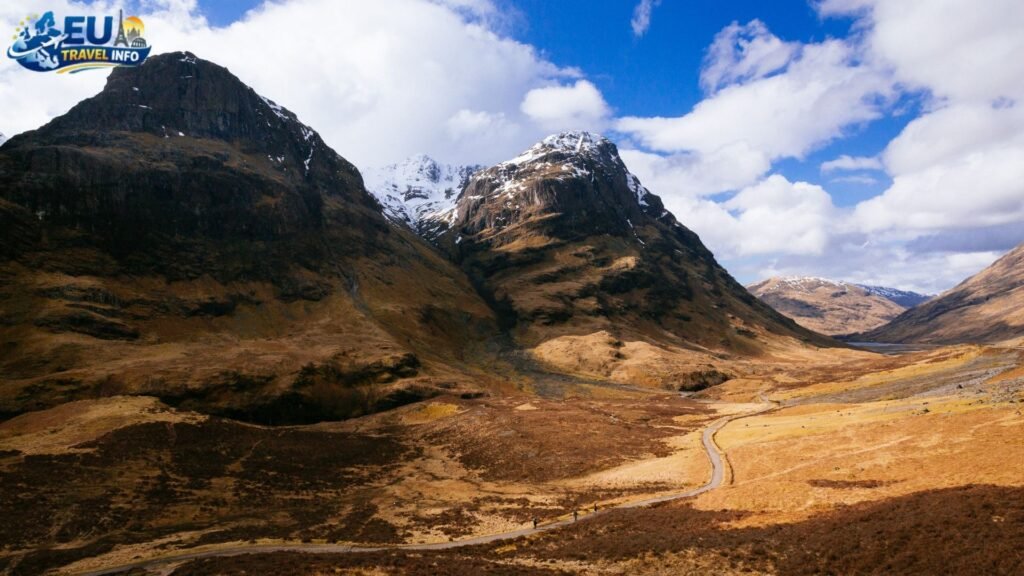
You head deeper into the Scottish Highlands. You pass through the Cairngorms National Park. Later, you reach Inverness, the capital of the Highlands. The highlight of today is a cruise on Loch Ness. You look for “Nessie” in the deep waters.
On top of that, you see Ben Nevis. It is the highest mountain in Britain. The landscape is rugged and beautiful. You return to Pitlochry for another night in the palace.
Day 5: Independence and Innovation
You travel south to Stirling Castle. This castle is a symbol of Scottish independence. It sits high on Castle Hill. Many sieges happened here during the Wars of Independence. Later, you see the “Bonnie Banks” of Loch Lomond. It is the largest lake in Scotland.
Finally, you reach Glasgow. Glasgow is the most populous city in Scotland. It was a center of shipbuilding during the Industrial Revolution. Now, it is a vibrant city of art and music. You stay at a modern hotel by the River Clyde.
Crossing the Sea: Northern Ireland
Day 6: The Ferry to Belfast
You spend your morning in Glasgow. You visit the Glasgow Cathedral. It is an almost complete church from the 13th century. Later, you drive to Cairnryan Ferry Port. You board a ferry for Belfast City.
Gradually, the Scottish coast fades. You arrive in Northern Ireland after a two-hour trip. You stay at the historic Europa Hotel. It is right across from the Grand Opera House.
Day 7: Murals and Myths
Belfast is a city reborn. You take a tour with a local guide. You see the Belfast Murals on the Shankill and Falls Roads. These artworks tell the story of the city’s past struggles for peace.
Additionally, you visit the Giant’s Causeway. This is a UNESCO World Heritage site. You see 40,000 basalt columns that lock together. Folklore says a giant named Finn McCool built them as a path to Scotland. On top of that, you drive to Donegal and stay in a real castle, Lough Eske Castle. It is a 5-star luxury experience.
The Wild West: Into the Republic
Day 8: Pottery and Poetry
You travel south toward Galway. First of all, you visit Belleek Pottery. It is one of the oldest potteries in the world, founded in 1857. Later, you stop in Drumcliffe. This is the final resting place of the poet W.B. Yeats. You can read his famous epitaph on the grave. Finally, you reach Galway. It is the cultural and artistic hub of Ireland.
Day 9: Abbeys and Sheepdogs
You travel through the wild landscape of Connemara. Oscar Wilde called this place “savage beauty”. You see mountains, lakes, and bogs. At Glengowla Mines, you watch a sheepdog demonstration. You see how a farmer and his dogs work together to herd sheep. It is a true taste of rural Irish life.
Additionally, you visit Kylemore Abbey. It is one of the most romantic buildings in Ireland. It sits at the base of a mountain by a lake. Later, you stop at Killary Fjord. It is the only true fjord in Ireland.
Day 10: The Burren and The Cliffs
You drive down the Atlantic coast. You see The Burren. In Gaelic, this means “rocky land”. It is a vast limestone plateau. Later, you reach the Cliffs of Moher. They rise 702 feet (214 meters) high. They stretch for 9 miles (14 kilometers) along the coast. Therefore, you will want your camera ready for the sunset. Finally, you arrive in Killarney for a two-night stay.
Day 11: The Ring of Kerry
Today is about the Ring of Kerry. This is a world-famous driving route on the Iveragh Peninsula. You see mountains and coastal villages. You stop at the Blind Piper Pub for a traditional lunch.
On top of that, you visit Killarney National Park. It was the first national park in Ireland. You see the majestic Lakes of Killarney. You also visit the Skellig Experience. It tells you about the Skellig Islands, where monks lived in beehive huts in the 6th century.
The Grand Finale: Dublin and Beyond
Day 12: Stones and Kings
You head toward Dublin. First of all, you visit Blarney Castle. It was built in 1446. You climb the stairs to kiss the Blarney Stone. Legend says this gives you the “gift of the gab”. Additionally, you shop at the Blarney Woollen Mills.
Later, you visit the Rock of Cashel. This fortress was the seat of kings for 900 years. It rises dramatically from the plains of Tipperary. High King Brian Ború was crowned here in 977. Finally, you reach Dublin City, the capital of Ireland.
Day 13: Emigrants and Guinness
Dublin is a vibrant city on the River Liffey. You visit EPIC: The Irish Emigration Museum. It tells the story of 10 million people who left the island over 300 years.
Additionally, you visit Christ Church Cathedral. It is almost 1,000 years old. You see the medieval crypt and a copy of the Magna Carta. Later, you tour the Guinness Storehouse. You learn how the “black stuff” is made. Finally, you enjoy a complimentary pint in the Gravity Bar with a view of the city.
Your final night ends with a Traditional Music Night. You eat dinner and watch Irish dancers. It is a perfect way to say goodbye.
Day 14: Departure
Your uk scotland and ireland itinerary ends today. After a final breakfast, you transfer to Dublin Airport. You carry memories of castles, cliffs, and new friends.
Planning a Trip with Different Durations
You might not have 14 days. However, you can still see the highlights.
- scotland and ireland itinerary 7 days: Focus on one city in each country. Spend three days in Edinburgh and four in Dublin. Use day tours to see the Highlands or the Cliffs of Moher.
- scotland and ireland itinerary 10 days: This is a popular middle ground. You can see Edinburgh, the Highlands, Belfast, and Dublin.
- london scotland and ireland itinerary: If you start in England, look for an 18-day tour. You start in London, see Stonehenge and York, and then follow the Scotland and Ireland path. This is the best scotland and ireland itinerary for those who want to see it all.
Driving vs. Group Tours: What You Need to Know
You have two main choices for travel. You can drive yourself or join a group tour.
Driving in Ireland and Scotland
If you choose a scotland and ireland trip itinerary where you drive, remember a few facts. First of all, you drive on the left side of the road. North American drivers do not need an international license. However, you must have held your full license for two years.
Similarly, speed limits are strict. In built-up areas, it is 30 mph (50 kph). On motorways, it is 70 mph (110 kph). Plus, do not drink and drive. The limit is 0.08%, and the penalties are heavy.
Additionally, manual cars are much cheaper to rent than automatics. If you want an automatic, book it early. On top of that, parking is enforced by “efficient” companies. Avoid illegal spots to prevent your car from being towed.
The Benefits of a Group Tour
Many travelers prefer to leave the driving to an expert. Reviews show that guides like Paddy O’Farrell or Pat Prendergast make the trip special. They share history and jokes. They know the narrow roads.
On top of that, group sizes are often small. Some tours cap at 26 guests. You have plenty of room to spread out on a large bus. Plus, someone else handles your luggage. This allows you to relax and look out the window.
Money and Logistics
First of all, know your currencies. In Scotland and Northern Ireland, you use the Pound Sterling (£). In the Republic of Ireland, you use the Euro (€). Therefore, you will need two types of cash.
Additionally, tipping is different than in the USA. In restaurants, a 10-15% tip is normal. You do not need to tip at a pub bar. Coach drivers and guides often receive a tip at the end of the day or trip.
Similarly, you must think about health. Bring your medications in original bottles. Pharmacies are called “chemist shops” there. Plus, ensure your travel insurance is active.
Hidden Gems to Add to Your List
If you have extra time, look for these “off the beaten path” spots.
- The Dark Hedges: An avenue of twisted trees in Northern Ireland. It looks like a fairytale.
- Rathlin Island: A place of peace with puffins and seabirds.
- The Gobbins Cliff Path: An exhilarating walk along the edge of the coast.
- Silent Valley Reservoir: A calm oasis in the Mourne Mountains.
Additionally, consider the Wild Atlantic Way. This is a 1,500-mile driving route. it passes through some of the most rugged scenery in the world.
Your 2026 Travel Summary
You are about to embark on the trip of a lifetime. Scotland and Ireland are countries of storytellers. You will hear legends of giants at the Causeway. You will feel the weight of history at Edinburgh Castle. On top of that, you will meet the friendliest people in the world.
Therefore, do not wait. 2026 is the year to see the Gaelic heartlands. Pack your layers. Prepare for the rain. Get ready for the greenest hills you have ever seen. Whether you choose a scotland and northern ireland itinerary or the full 14-day tour, you will not be disappointed.
Frequently Asked Questions
How many days do you need for Ireland and Scotland?
You need at least 14 days to see the highlights of both countries at a comfortable pace. If you only have 7 or 10 days, you should focus on a few key cities and nearby attractions.
Can I visit Scotland and Ireland in one trip?
Yes. You can easily travel between them by ferry or flight. Ferries from Northern Ireland to Scotland take about two hours. Flights between major cities like Dublin and Edinburgh are frequent and short.
Should I do Ireland and Scotland together?
Yes. These two “Gaelic nations” share a similar culture and history. Visiting them together allows you to compare their unique landscapes, from the Highlands to the Wild Atlantic Way.
Concluding Words
The Ultimate Scotland and Ireland Itinerary Guide 2026 for Travelers shows that two weeks is the perfect time to experience these lands. You can walk through medieval castles in Edinburgh and kiss the Blarney Stone in Ireland.
You can cruise Loch Ness and stand on the massive Cliffs of Moher. By planning for the spring or fall, you avoid the biggest crowds and enjoy pleasant weather. Whether you drive yourself or take a guided tour, the history and natural beauty will stay with you forever.