You are standing on a sun-drenched balcony. The smell of salty sea air and fresh citrus fills your lungs. Below you, a maze of ancient stone streets hums with life. This is not just a vacation. This is Sicily. If you love history, art, and food that makes you want to cry with joy, you have found your paradise. This Sicily italy itinerary will guide you through the heart of the Mediterranean.
Sicily acts as a bridge between Europe and Africa. It is a land where Greeks, Romans, Arabs, Normans, and Spaniards all left their mark. You can see it in the architecture. You can taste it in the pasta. By the time you finish this guide, you will be ready to pack your bags for the ultimate Sicily italy tour.
Why You Must Visit Sicily in 2026
Sicily is the largest island in the Mediterranean Sea. It is a place of massive contrasts. You will find smoking volcanoes and crystal-clear turquoise waters. You will see crumbly Greek ruins next to grand Baroque cathedrals.
First of all, the weather is nearly perfect. If you visit from April through early June or mid-September through early November, you will find warm sun and cool breezes. Average high temperatures usually sit around 24°C or 75°F. Therefore, you can explore all day without melting in the summer heat.
Additionally, Sicily is home to seven UNESCO World Heritage Sites. This is an incredible concentration of history on one island. From the mosaics of a Roman villa to the largest active volcano in Europe, the culture here is deep.
Planning Your Sicily Italy Route
How much time do you have? This is the big question. You could spend a month here and still miss things. However, most travelers choose between one and two weeks.
The Sicily Italy 1 Week Itinerary
If you only have seven days, do not try to see the whole island. You will spend all your time in a car. Instead, focus on one side. A Sicily italy itinerary 7 days long should focus on the east coast.
- Day 1-2: Fly into Catania and head to Taormina.
- Day 3: Visit Mount Etna.
- Day 4-5: Drive to Syracuse and Ortigia.
- Day 6: Explore the Val di Noto (Noto or Ragusa).
- Day 7: Return to Catania and fly out.
The Sicily Italy 10 Day Itinerary
A Sicily italy 10 day itinerary allows you to see more of the southern coast. This is a great balance of speed and relaxation.
- Day 1-2: Taormina.
- Day 3: Mount Etna.
- Day 4: Cefalù.
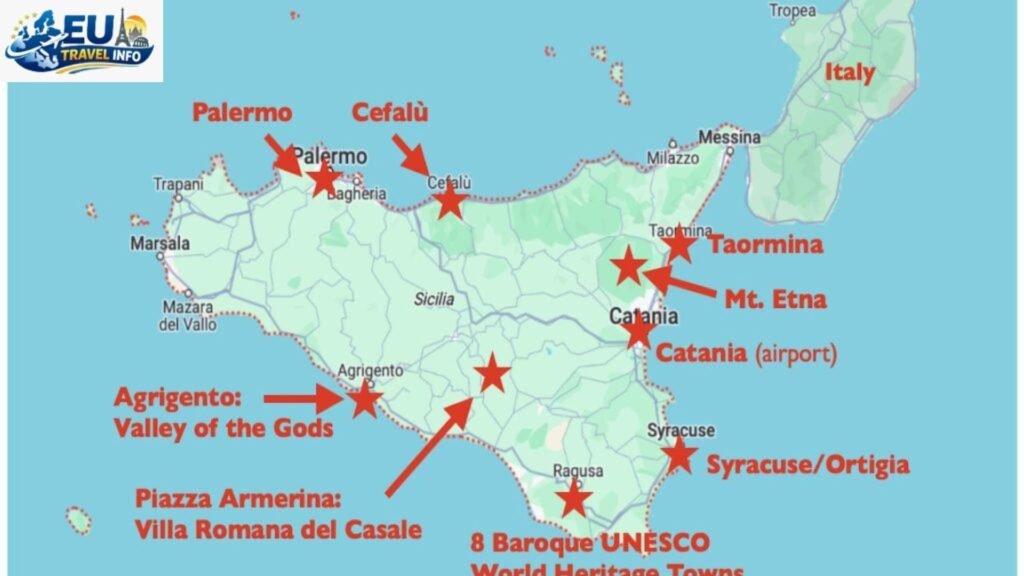
- Day 5-6: Palermo.
- Day 7: Agrigento and the Valley of the Temples.
- Day 8-9: Ragusa and Noto.
- Day 10: Syracuse and the airport.
The Ultimate 14-Day Sicily Italy Vacation Itinerary
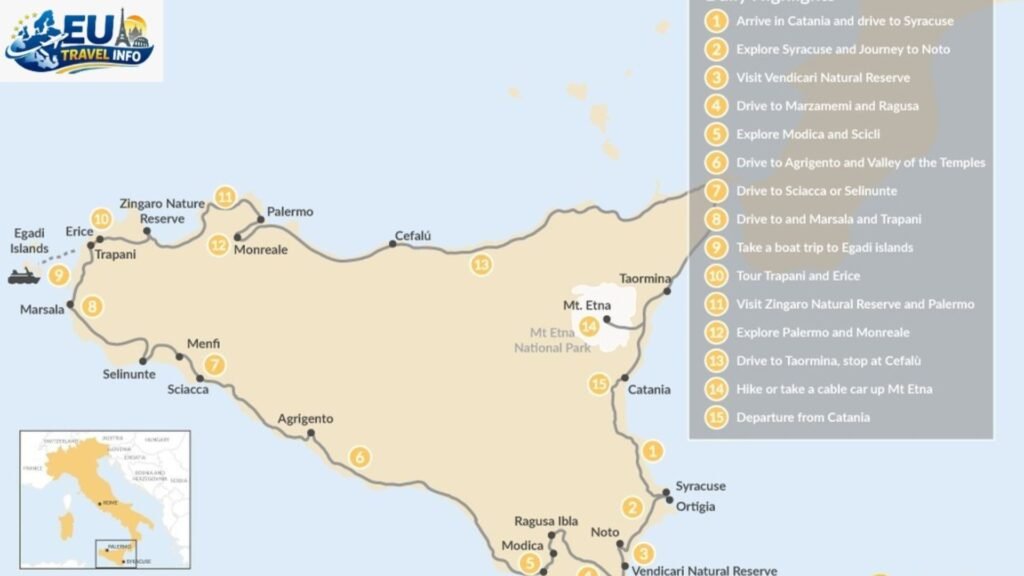
If you want the full experience, two weeks is the gold standard. This Sicily italy travel itinerary lets you loop the entire island. You will start and end in Palermo to avoid extra car rental fees.
Driving in Sicily: What You Must Know
You probably heard that driving in Sicily is a nightmare. Some of that is true. However, a car gives you the total freedom you need to find hidden gems.
The Car Rental Secret
First of all, do not chip out on insurance. Get 100% full coverage. Rental companies in Sicily can be a little sneaky with scratches and bumps. When you pick up the car, take a video of every single inch of it.
Secondly, rent a small car. The streets in historical centers are tiny and narrow. You do not want to be stuck in a giant SUV on a road made for donkeys. Plus, parking is much easier with a small vehicle.
Avoiding Theft and Fines
Theft is a concern, but you can be smart about it. Do not leave luggage visible in the car. Always put your bags in the trunk. Interestingly, the Fiat Panda is the most stolen car in Sicily, followed by the Fiat 500. If you can, pick a different model to lower your risks.
Watch out for ZTL zones. These are “Limited Traffic Zones” in city centers. If you drive past the sign with the red circle, a camera will record your plate. You will get a fine of €200 or more in the mail.
The Sicilian Driving Style
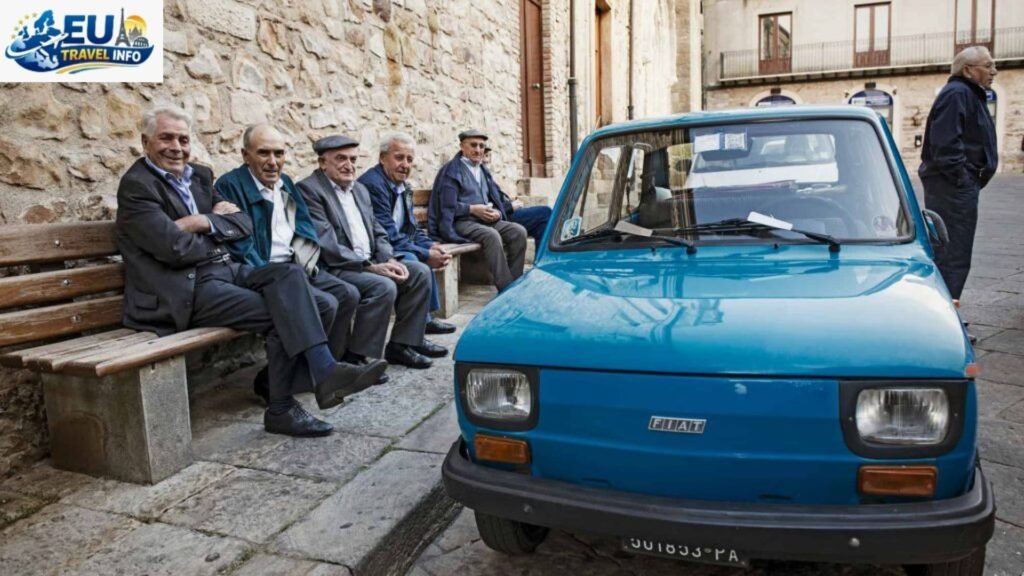
Traffic lights and stop signs are often seen as “kind suggestions” rather than strict rules. People will cut you off. They will honk the second the light turns green. Do not take it personally. Just focus on your own path and assumed that a moped will zoom past you at any moment.
Region 1: Palermo and the Northwest
Your Sicily italy honeymoon itinerary or cultural tour likely starts in Palermo. This city is a concrete jungle of history.
Palermo: The Capital of Chaos
Palermo is overwhelming. It is loud. It is gritty. It is also beautiful. You should spend at least two days here.
First of all, visit the Norman Palace. Inside, you will find the Palatine Chapel. The golden mosaics are so bright they seem to glow. Later, walk to the Palermo Cathedral. You can actually walk on the rooftop for a view of the whole city.
On top of that, you must visit the markets. Ballarò and Il Capo are famous. This is where you find the soul of Sicily. Try the street food. If you are brave, try a panino con la milza (spleen sandwich). If not, stick to the arancine (fried rice balls).
Monreale: A Golden Masterpiece
Just outside Palermo lies Monreale. The cathedral here is a UNESCO site. It features over 6,400 square meters of golden mosaics. It is one of the most stunning sights in all of Italy.
Cefalù: The Coastal Escape
Gradually, you will want to leave the city noise. Drive east to Cefalù. This town sits between a massive rock and a sandy beach. Hike to the top of Rocca di Cefalù for a view that will take your breath away. Finally, wander through the medieval old town and visit the Cathedral.
Region 2: The East Coast Gems
This region is the most popular part of any Sicily and southern italy itinerary. It is dominated by a giant: Mount Etna.
Taormina: The Resort Town
Taormina is where you go to feel like a movie star. It is perched on a cliff overlooking the Ionian Sea.
First of all, go to the Ancient Theater of Taormina. It was built by the Greeks and later used by the Romans. The view of the stage with Mount Etna in the background is iconic.
Similarly, take the cable car down to Isola Bella. This tiny island is connected to the beach by a narrow strip of sand at low tide. It is a perfect spot for a sunset drink.
Mount Etna: The Great Volcano
You cannot miss Mount Etna. It is the highest active volcano in Europe at 3,350 meters. It has been active for 500,000 years.
You have several ways to visit. You can take a cable car up from Rifugio Sapienza. Later, a jeep can take you even higher. If you love nature, you can hike through old lava flows that look like the moon.
Additionally, the soil on the slopes is incredibly fertile. This makes it a world-class wine region. The red wines are light and acidic, almost like a Pinot Noir. Visit a winery like Cottanera or Planeta for a tasting.
Region 3: Syracuse and the Baroque South
As you move south, the architecture changes. This area was destroyed by a massive earthquake in 1693. The towns were rebuilt in a grand style called Sicilian Baroque.
Syracuse and Ortigia
Syracuse was once the most powerful Greek city in the world. Today, the main draw is the island of Ortigia.
First of all, visit the Neapolis Archaeological Park. You will see a massive Greek theater carved into the rock. Later, cross the bridge to Ortigia. The Piazza Duomo is one of the most beautiful squares in Italy. The cathedral there was actually built around an ancient Greek temple. You can still see the original columns inside the walls!
The Val di Noto: Cities of Stone
The towns of Noto, Modica, and Ragusa are all UNESCO treasures.
- Noto: People call this the “Garden of Stone”. The buildings are made of honey-colored limestone that glows gold at sunset.
- Modica: This town clings to the side of a deep gorge. It is famous for chocolate. They use an ancient Aztec recipe that gives the chocolate a unique, grainy texture.
- Ragusa: The old town, Ragusa Ibla, is a maze of cobblestone streets and hidden plazas.
For a true taste of the region, try the scaccia. This is a traditional street food that looks like a lasagna but is made with thin layers of dough and savory fillings.
Region 4: The Valley of the Temples
Your Sicily italy route must include Agrigento. This is where you find the Valley of the Temples.
This site contains eight magnificent temples built between 510 BC and 430 BC. The Temple of Concordia is the star. It is almost perfectly intact after 2,500 years. It is one of the most important Greek sites in the world.
Plus, for a special treat, stay at the Villa Athena Resort. It sits right next to the park. You can see the temples illuminated at night from your balcony.
Region 5: The Northwest and Hidden Coasts
Finally, head back toward the west to see a more rugged side of the island.
Selinunte and Segesta
If you have not had enough of Greek history, visit Selinunte. It is a massive archaeological park right on the sea. You can actually walk inside the temples here, which is very rare.
Segesta is also incredible. It features a lone temple on a hill and a theater with a stunning view of the valley below.
The Zingaro Nature Reserve
If you want to stretch your legs, visit Zingaro. It was Sicily’s first nature reserve. A 7-kilometer path winds along the coast. You can stop at small, hidden coves to swim in water that looks like blue glass.
Erice: The Town in the Clouds
Perched on top of a mountain, Erice is a medieval dream. The streets are made of polished stone. On a clear day, you can see all the way to Africa. Therefore, it is the perfect place to end your trip with a pastry and a view.
The Aeolian Islands: A Volcanic Add-on
If you have extra time, consider the Aeolian Islands. These seven volcanic islands sit north of Sicily.
- Lipari: The largest and busiest island.
- Vulcano: Famous for its therapeutic mud baths and sulfur smells.
- Stromboli: This volcano erupts almost every night. You can take a boat at sunset to watch the “Lighthouse of the Mediterranean” glow.
- Salina: The greenest island, famous for its sweet Malvasia wine.
You can reach them by ferry or hydrofoil from Milazzo.
Sicily Italy Travel Tips for 2026
- Eat the Pasta: Try Pasta alla Norma in Catania. It has fried eggplant, tomato sauce, and salty ricotta cheese.
- Watch the Sun: Many sites, like the Valley of the Temples, are best at “golden hour” for photography.
- Carry Cash: While big hotels take cards, small shops and parking meters often require coins or bills.
- Slow Down: Sicily runs at its own pace. Do not expect fast service. Instead, enjoy the dolce far niente—the sweetness of doing nothing.
FAQ
How many days are needed to visit Sicily?
You need at least 7 to 10 days to see the major highlights. If you want to explore the whole island without rushing, 14 days is the best choice.
Is Sicily or Amalfi better?
This depends on your style. Amalfi is smaller, more crowded, and very expensive. Sicily is much larger and offers a wider variety of experiences, from active volcanoes to deep ancient history. Sicily also tends to be better for your budget.
Is 2 weeks in Sicily too long?
Absolutely not. You could easily fill a month in Sicily. Two weeks allows you to see the main regions without spending every single day in your car.
Can you do Sicily in 7 days?
Yes, but you should not try to see everything. Pick either the East Coast (Taormina, Syracuse, Etna) or the West Coast (Palermo, Cefalù, Erice).
Conclusion
This Sicily Italy Itinerary Guide 2026 for Culture Lovers shows that the island is a world of its own. You can walk through Greek temples, taste chocolate made from ancient recipes, and watch a volcano erupt all in one trip. Sicily is not just a destination. It is an experience that stays in your heart forever.