Imagine you are standing on a cobblestone street in old Lisbon. The sun feels warm on your back. You hear the faint sound of a guitar. This is the start of your 2026 adventure. Spain and Portugal sit next to each other on the Iberian Peninsula. These two countries share more than 1,200 kilometers of border. They offer old castles, amazing food, and a very relaxed way of life. You will find that these nations are perfect partners for a long trip.
You need to plan your time well. Spain and Portugal Itinerary options can range from one week to three weeks. Many travelers love the Spain and Portugal itinerary 14 days because it hits the major highlights without a rush. First of all, you must decide how to move around. You can choose a Spain and Portugal itinerary by train to see the sights from a window. Additionally, you might prefer a road trip to find small towns. On top of that, some people fly between big cities like Madrid and Lisbon to save time.
Choosing Your Trip Length

You should think about how much you want to see. A Spain and Portugal itinerary 7 days is very short. You will likely only see two big cities like Lisbon and Madrid. However, a Spain and Portugal itinerary 10 days gives you a little more breathing room. You could add a stop in a place like Seville or Porto. Gradually, you might realize that two weeks is the “sweet spot”. A Spain and Portugal itinerary 12 days or a Spain and Portugal itinerary 14 days lets you see the south and the north.
For the true explorers, a Spain and Portugal itinerary 16 days, a Spain and Portugal itinerary 18 days, or even a Spain and Portugal itinerary 21 days is best. These long trips allow you to see the hidden gems. You can visit the green mountains in the north and the dry plains in the center. Plus, if you travel with kids, a slower pace helps everyone stay happy.
Logistics and Getting Around
You have a few ways to cross the border. First of all, the train is a great choice for comfort. There is a train called the Comboio Celta that connects Vigo in Spain to Porto in Portugal. It takes about 2 hours and 22 minutes. Similarly, you can take a bus if you want to save money. Companies like Alsa and Flixbus run many routes between the countries.
Later, you might decide to rent a car. Driving is the best way to see small villages. Therefore, you should know about the tolls. In Portugal, they use an automated system called Via Verde. You should ask your rental agency for a transponder to make payment easy. On the contrary, parking in big cities like Madrid or Barcelona is very hard and costs a lot of money. You should park your car and walk once you reach a city.
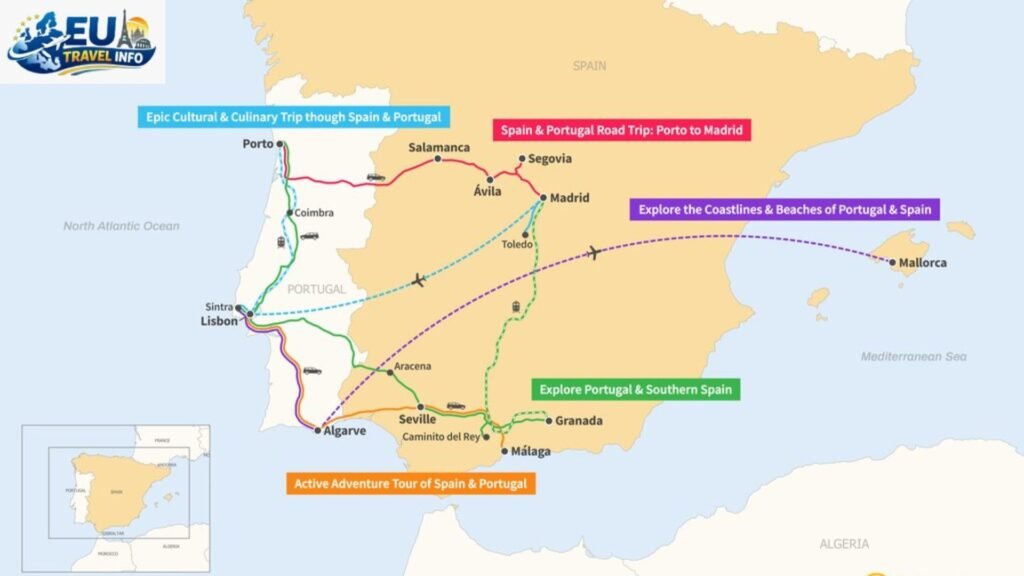
A 14-Day Adventure: The Southern Route
You start your journey in Lisbon. This city has seven hills and beautiful light. First of all, you should visit the Belem neighborhood. Portuguese explorers sailed from here in the 15th century. You must taste a codfish cake or a sweet pastry. Later, you can go to a Fado show to hear soulful music. Gradually, you will fall in love with the terracotta roofs and blue tiles.
On top of that, you can take a day trip to Sintra. You will see the Pena Palace there. It looks like a colorful castle from a fairy tale. Therefore, you should book your tickets early. Additionally, you might visit Cascais for a view of the ocean.
You move south to the Alentejo region next. You visit Evora, which is a UNESCO World Heritage Site. You will see an old Roman temple and a church made of bones. First of all, the Chapel of Bones is very strange but interesting. Later, you can see the Cromlech of Almendres, which is a stone circle older than Stonehenge. It dates back over 7,000 years.
You then cross into Spain. You reach Seville, the heart of Andalusia. The air smells like orange blossoms. First of all, you must see the Real Alcazar, a palace with beautiful gardens. Similarly, the Seville Cathedral is one of the largest in the world. Gradually, you will find your way to a Flamenco show. The dancers show a lot of passion and power.
On top of that, you can visit Granada to see the Alhambra. This Moorish palace sits on a hill with snowy mountains behind it. Therefore, you must get tickets months in advance. Finally, you head to Madrid, the capital of Spain. You can visit the Prado Museum to see world-famous art. You will find that life in Madrid is very busy and fun.
A 15-Day Adventure: The Northern Loop

You might prefer the green landscapes of the north. First of all, you start in Lisbon and head to Porto. You take a boat ride on the Douro River. You drink a glass of Port wine while you look at the old city. Gradually, you move into Galicia in Spain.
You visit Santiago de Compostela, the end of a famous pilgrimage route. Similarly, you can see the Roman walls in the town of Lugo. Additionally, you travel through the Peaks of Europe mountains. The views are breathtaking. On top of that, you visit Bilbao to see the Guggenheim Museum. It is a very modern building that looks like a ship.
Later, you reach Barcelona on the Mediterranean coast. You see the strange and beautiful buildings of Antoni Gaudi. First of all, the Sagrada Familia is a church that is still being built. Gradually, you walk down The Ramblas, a busy street with shops and cafes. Therefore, you will never run out of things to see in this city.
The Best Places to Stay: Paradors
You should try staying in a Parador while in Spain. These are hotels run by the state in historic buildings. You can sleep in an old castle, a monastery, or a palace. First of all, the Parador de Santiago de Compostela is one of the oldest hotels in the world. It has been open since 1499. Similarly, the Parador de Leon is inside a stunning 16th-century convent.
Additionally, the Parador de Granada is very special because it is inside the Alhambra grounds. You can walk the gardens after the tourists leave. On top of that, these hotels have great restaurants. They serve food from the local region. Though some are expensive, many cost around 100 Euros per night. Therefore, it is a great way to feel the history of Spain.
Eating and Drinking Like a Local
You must learn the eating schedule in the Iberian Peninsula. In Spain, people eat lunch late, around 2:00 PM. On the contrary, dinner does not start until 9:00 PM or later. First of all, you should try tapas or pintxos. These are small plates of food meant for sharing. Similarly, you must try Iberian ham, which comes from acorn-fed pigs.
Additionally, you should try paella in Valencia. This is a famous rice dish with saffron. Plus, you can try fresh seafood in Galicia or the Algarve. Gradually, you will find that food is a big part of the culture here. People spend a lot of time at the table with friends and family.
Therefore, you should know about tipping. Tipping is not expected in Spain or Portugal like it is in America. First of all, workers earn a regular wage. You can just round up the bill or leave a few coins. Similarly, if you are at a tapas bar, you do not need to tip at all. However, if the service is very good at a nice restaurant, you can leave 5% to 10%. Finally, you should always tip in cash to make sure the server gets the money.
Practical Tips for Your Adventure
You should keep these facts in mind. The currency in both countries is the Euro. The electricity is 230 volts. First of all, Spain is in the Central European Time zone. Similarly, Portugal is one hour behind Spain. Additionally, you must carry your ID or passport at all times. The police can ask to see it at any moment.
On top of that, you should be careful with your bags in big cities. Pick-pocketing is common in crowded places like Barcelona and Madrid. Therefore, you should use a secure bag and stay alert. Gradually, you will learn to spot the “shell game” or other scams. Finally, the emergency number in both countries is 112.
Festivals and Fun
You might want to time your trip with a festival. First of all, Holy Week (Semana Santa) is a huge event in many cities. You will see long parades with religious statues. Similarly, the Fallas in Valencia is a wild festival where they burn giant statues in March. Additionally, you can see the Running of the Bulls in Pamplona in July.
On top of that, you can celebrate New Year’s Eve in Madrid. The tradition is to eat 12 grapes as the clock strikes midnight. One grape for every second!. Therefore, you should buy a small pack of grapes before the big night. Finally, you will see a big fireworks show at Puerta del Sol.
Conclusion of the Guide
You have many choices for your 2026 trip. Whether you pick a Spain and Portugal itinerary 7 days or a Spain and Portugal itinerary 21 days, you will have a great time. You will see old walls, taste rich wine, and feel the warm sun. First of all, plan your route. Later, pack your bags. Finally, enjoy the adventure of a lifetime!
FAQ
How many days for Portugal and Spain?
You should plan for at least 14 days to see the main sights of both countries without feeling rushed. Though you can do a shorter trip in 7 or 10 days, you will only see a few cities.
What’s the best month to go to Spain and Portugal?
The best time to visit is in the spring (April to June) or the fall (September to October). The weather is not too hot, and there are fewer crowds. Additionally, the winter is mild in the south, but it can be rainy in the north.
Should I do Spain or Portugal first?
You can start in either country. It often depends on which city is cheaper for you to fly into. The 14-day route is very flexible and works both ways.
Is it easy to travel between Spain and Portugal?
Yes, it is easy. You can take a bus, a plane, or a train in the north. However, there is no high-speed train between the countries yet. Driving is also a great option if you like the open road.
Concluding Words
Spain and Portugal are amazing places for a 2026 adventure. You can find everything from old Roman ruins to modern art museums. You will enjoy the slow life, the great food, and the friendly people. Plan your route well and get ready for a trip you will always remember.