
You dream of the cobblestone streets in Rome. You imagine the scent of fresh croissants in a Paris bakery. Perhaps you want to see the Swiss Alps or the sunny beaches of Spain. The flight price is the only thing that stands in your way. You see a price of $1,400 and your heart sinks. You wonder if you can ever afford this trip. Stop right there. You can save hundreds of dollars with the right timing. It is all about the data. It is about the strategy.
I have spent years tracking these patterns. I have seen the mistakes that cost travelers $200 to $400 per ticket. It is frustrating. I know. However, I have also found the “sweet spot” that makes these trips possible. This guide will show you exactly how far in advance to book flights to Europe so you can keep your money for the actual vacation.
First of all, you must understand that airfare does not follow a simple path. It moves in waves. It reacts to competition and demand. Therefore, you need a plan that works in 2026. Forget the old myths. They will only cost you more. Instead, let us look at the real numbers.
The Goldilocks Window: Not Too Early, Not Too Late
You might think that booking a year in advance is the smartest move. It feels safe. It gives you a sense of certainty. On the contrary, this is often a mistake. Most airlines release their schedules about 330 to 365 days out. At that time, prices are often at their highest. The airlines know that early planners will pay a premium for peace of mind.
The real magic happens in what experts call the Goldilocks Window. For international travel, this window is typically 2 to 8 months before you depart. During this period, airlines begin to adjust their prices based on how many seats are still empty. They want to fill the plane. They start to compete.
If you want to know when to book flights to europe, you should aim for specific ranges based on the season. For a spring trip, you should look 6 to 10 weeks out. For a summer adventure, you need 2 to 4 months of lead time. This balance ensures you do not pay the “early bird” penalty or the “last-minute” panic price.
Spring 2026: The Critical February Window
You are planning to visit Europe in March, April, or May of 2026. You should mark January and February on your calendar. These are the prime months for your search. Gradually, you will see prices stabilize as airlines release more inventory.
Specifically, when is the best time to book international flights to europe for the spring? You should ramp up your search in January 2026. At that time, many airlines run winter sales to recover from the holiday season. You might find a roundtrip to Paris for $650 or Dublin for $550. These prices are a total steal.
Additionally, you must watch the calendar for European holidays. Prices for flights during Easter week—which falls around April 5, 2026—can be 2 to 3 times higher than normal. You should book these high-demand dates by early January at the latest. If you wait until March, you will pay a heavy price.
Summer 2026: Why February Is Your Best Friend
Summer is the most popular time to go. Everyone wants to be there. The weather is perfect. The kids are out of school. Because of this demand, the booking strategy changes. If you want to know when to book flights for international travel in the summer, the answer is February 2026.
February is the “sweet spot” for June and July departures. It is that brief moment between the high prices of early booking and the rising costs of the spring rush. By mid-March, prices will climb 15% to 25% as availability disappears. Plus, the difference between a February booking and an April booking can be as much as $400 per ticket. Think about that. That is enough for several nights in a luxury hotel.
You should aim for these price ranges in the summer from major hubs like New York or Boston:
- Economy: $650 – $900.
- Premium Economy: $1,400 – $1,800.
- Business Class: $3,000 – $4,500.
Similarly, if you are flying from the West Coast, expect to pay $800 to $1,200 for economy. If the numbers you see are higher, you might be looking at peak dates or poor routes.
The Great Tuesday Myth: Let It Go
You have probably heard the old rule. You must book on a Tuesday at 3 PM to get the best deal. People have repeated this for decades. It feels like a secret code. However, it is almost entirely false in 2026.
A massive analysis of 847,000 international flights showed that booking on a Tuesday saves only $3 to $7 on average. That is less than the price of a coffee at the airport. Modern airline systems update their prices 4 to 6 times every day using machine learning. They do not wait for a specific afternoon to drop fares.
Instead of worrying about which day you buy the ticket, you should focus on which day you actually fly. This is where the real savings live. When to book international flight tickets is less important than when to sit in the seat.
Midweek Magic: When To Fly
You can save a lot of money by choosing the right day of the week to depart. Weekend flights are for leisure travelers and business people. They are expensive. Midweek flights are the budget traveler’s best friend.
You should aim to fly on a Tuesday, Wednesday, or Thursday. These days are consistently 13% to 20% cheaper than flying on a Sunday. On a popular route like London to Rome, this can save you €30 to €80 per person.
Additionally, you should look for early morning or late-night flights. These off-peak hours often come with lower fares. It is a simple trade-off. You lose a little sleep. You gain a lot of extra cash for your trip.
The Shoulder Season: The Hidden Gem

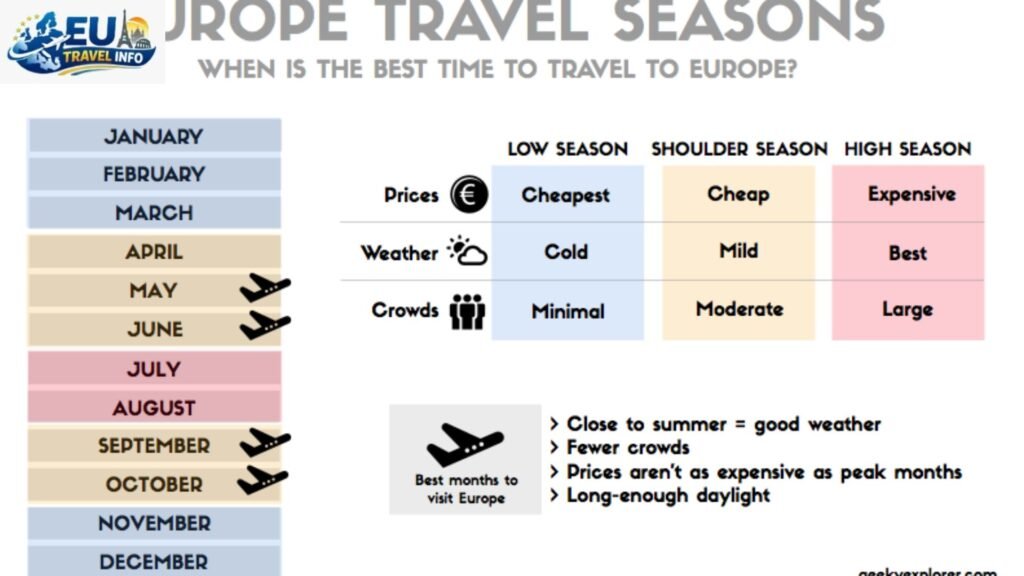
You want the best weather with the lowest prices. You should look into the shoulder season. This is the period between the peak summer rush and the dead of winter. In Europe, this usually means mid-March to mid-June and mid-September to November.
The weather at this time is usually between 45 and 65 degrees Fahrenheit. It is comfortable for walking. It is perfect for sightseeing. On top of that, crowds are much thinner. You do not have to fight for a spot at the Trevi Fountain.
Similarly, many resorts and airlines offer special discounts during these months. You can often find summer-like weather in late May or early September for $300 less per ticket. This is what winning looks like.
Where You Fly Matters: The Hub Strategy
You do not have to fly directly into your final destination. Sometimes, it is much cheaper to fly into a major hub and then take a budget flight or a train. This is a pro move.
The cheapest cities to fly into Europe from the US include:
- Paris (CDG): Often the most affordable entry point with the most deals.
- London (LHR/LGW): Huge competition among airlines keeps prices low.
- Dublin (DUB): A great gateway for Ireland and the UK.
- Madrid and Barcelona: Excellent for entering Southern Europe.
- Milan: Italy’s fashion center is surprisingly budget-friendly.
Finally, you can use the “Greek Islands Trick“. You fly into a cheap hub like London or Paris. Later, you use a budget airline like Ryanair or easyJet to get to your final, more expensive destination. Just be careful with those budget carriers.
The Budget Airline Trap: Calculate the Total Cost
You see a ticket for $49. It looks like a miracle. You are ready to click “buy.” Stop. You must look at the total trip cost, not just the headline fare.
Budget airlines like Norse Atlantic or PLAY offer low base prices, but they charge for everything else. You might pay $70 to $100 for a checked bag. You might pay $30 to $80 just to sit next to your spouse. Even a meal can cost you $30.
Gradually, that $49 fare climbs over $200. On the contrary, legacy carriers like United or Delta often include bags and meals in their international prices. If the price difference is under $50, you should go with the legacy carrier. The extra comfort and lack of hidden fees are worth it. You are on vacation to enjoy yourself. Not to be stressed about bag centimeters.
Leverage Technology: Tools for Your Search
You do not have to do this alone. You should use the tools that the pros use.
- Google Flights: This is the best tool for seeing a calendar of prices. You can see how much you save by moving your trip by just one day.
- Skyscanner: This site is great for finding small budget airlines that others might miss.
- Fare Alerts: You should set up alerts on sites like Going or Hopper. They will email you when prices drop.
- The 24-Hour Rule: Remember that you can usually cancel a flight within 24 hours of booking for a full refund. If you see a better deal right after you book, you can switch without a penalty.
Points and Miles: The Secret Weapon
You should not ignore loyalty programs. Even if you do not fly often, those points add up. First of all, sign up for free.
Interestingly, when cash prices are very high, airlines sometimes release more award seats. They would rather have a loyal member in a seat than fly it empty. Therefore, always check your points balance when the cash price looks scary. You might find a business class seat for the price of a few thousand miles plus some taxes.
The Open-Jaw Ticket: Save Time and Money
Most people book a roundtrip to the same city. They fly into Rome. They spend two weeks traveling to Paris. Then, they spend their last day on a long train ride back to Rome just to fly home. This is a waste of your precious time.
You should look for an open-jaw ticket. You fly into one city and out of another. For example, fly into London and out of Paris. Often, these cost the same as a regular roundtrip because the airline algorithm cares about the total distance. It eliminates backtracking. It lets you see more of the world.
Avoid the Peak Holiday Surges
You must be careful with specific dates in 2026. Europe has several public holidays that send prices through the roof.
- Easter Sunday (April 5, 2026): School holidays last for weeks. Avoid this time if you want to save.
- May Day (May 1): A huge holiday in France, Germany, and Italy. Long weekends mean high prices.
- Ascension Day (May 13, 2026): Another price spike for a long weekend.
- Whit Monday (May 24, 2026): The final spring holiday surge.
If you must travel during these times, you should book as early as possible. Mid-February is a good deadline for May trips.
Historical Lessons: Looking Back to Move Forward
You might see references to when to book international flights for 2023 or other past years. These are useful for seeing patterns. In the past, the advice was often the same: book 3 to 6 months ahead for the best results. The rules of supply and demand do not change much. The airlines always want to maximize their profit. You just have to be smarter than their algorithms.
Your 2026 Action Plan
- If you are booking in January: Lock in your April/Easter trips now.
- If you are booking in February: This is your prime window for summer (June/July).
- If you are booking in March: You can still find good deals for late summer and autumn.
Always remember the golden rule: Always calculate total trip cost, not headline fare.
FAQs
How far in advance should you book flights to Europe?
You should aim for 2 to 8 months before your trip. For spring travel, look 6 to 10 weeks out. For summer, the 2 to 4 month window is best, with February being the prime month to buy for June and July.
What is the airport 45 minute rule?
The sources do not provide a specific definition for a “45 minute rule.” However, travelers generally know that many airlines require you to be checked in and at the gate at least 45 minutes before a domestic flight, though international flights often require much more time. Always check your specific airline’s policy to avoid being denied boarding.
When should I book my international flights?
The best time is usually when you see a price that hits the historical average for your route. Use tools like Google Flights to see what is “typical.” Generally, 3 to 6 months is a safe bet for most international destinations.
What is the best day to book an international flight?
There is no single “best” day to click the buy button. The idea that Tuesday is the cheapest day is a myth that only saves about $3 to $7. Instead, monitor prices from Tuesday through Thursday to catch various pricing cycles and flash sales.
Concluding Words
Finding the best deals for your 2026 European vacation requires patience and a bit of data. You should avoid the old Tuesday booking myths and focus on the Goldilocks Window of 2 to 8 months out. Fly during the midweek—Tuesday, Wednesday, or Thursday—to save up to 20% on your airfare. Always look at the total cost of your ticket, including those sneaky budget airline fees. If you follow these steps, you will save hundreds of dollars and have a much better trip.