
You walk into a modern airport today and see giant planes waiting to take you across the ocean. It is easy to take this for granted. However, the history of how people first crossed the sea in the sky is full of danger and courage.
You might wonder exactly when was the first flight from America to Europe? The answer depends on what kind of flight you mean. A few brave souls did it first with stops, while others made a wild dash without stopping at all. Later, the regular person like you could finally buy a ticket for a seat.
First of all, you must look back to the year 1919. This was a time when planes were made of wood and fabric. Many people thought a trip across the Atlantic was impossible. The first flight from North America to Europe happened in May of that year. This was not a solo trip or a nonstop one. It was a massive mission by the United States Navy. They used a giant flying boat called the NC-4.
You can imagine the scene on May 8, 1919. Three planes, the NC-1, NC-3, and NC-4, took off from Rockaway, New York. They did not fly straight across. These planes were slow and needed lots of fuel. Therefore, they made several stops along the way. First, they stopped in Massachusetts and then Nova Scotia. Finally, they reached Newfoundland. This was the jumping-off point for the biggest part of the trip.
The Long Journey of the NC-4
The Navy did not leave anything to luck. They placed 53 warships along the route to help with navigation. These ships were like a string of lights across the dark water. On May 16, the planes left for the Azores Islands. This part of the trip was 1,200 miles long. Fog was a huge problem. However, the NC-4 managed to land at Faial Island on May 17. The other two planes were not so lucky and had to land in the ocean.
Later, the NC-4 took off again on May 27 and flew to Lisbon, Portugal. This was a historic moment. When did the first plane fly overseas? It was this very moment in May 1919. The NC-4 became the first aircraft to ever fly across the Atlantic Ocean. The entire trip from Newfoundland to Portugal took 10 days and 22 hours. The actual time in the air was 26 hours and 46 minutes.
You might think that was the end of the story. On the contrary, the flight continued. The crew flew to Spain and then to Plymouth, England, arriving on May 31. They had traveled a total of 4,526 statute miles. The total flying time for the whole adventure was 52 hours and 31 minutes. Commander Albert Cushing Read led the crew of six men. They were heroes. Additionally, the United States Congress later gave them Gold Medals for their work.
The Nonstop Race for Glory
Though the Navy did it first, the world wanted to see someone fly without any stops. A big prize of £10,000 was waiting for the first person to do it. This was the Daily Mail prize. Two British men, John Alcock and Arthur Brown, decided to try. They used a Vickers Vimy bomber that they changed to carry more fuel.
You can feel the tension as they took off from St. John’s, Newfoundland on June 14, 1919. Their plane had two Rolls-Royce Eagle engines. It was not a smooth ride. They faced thick fog and snowstorms. At one point, their instruments even iced up. They had no radio contact because their generator failed. Plus, the wind was very strong.
Finally, after 15 hours and 57 minutes in the air, they saw land. They landed in Clifden, Ireland on June 15, 1919. It was a rough landing. They thought they were landing on a green field, but it was actually a peat bog. The plane’s nose went down into the mud, but the men were safe. They had flown 1,890 miles at an average speed of 115 miles per hour. This was the first nonstop flight from North America to Europe.
The Solo Legend: Charles Lindbergh
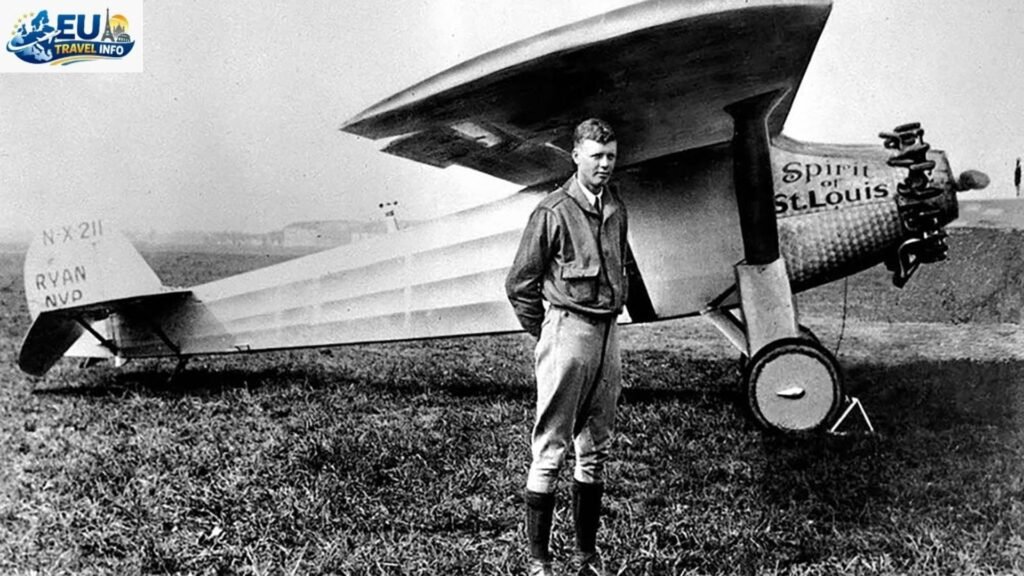
Similarly, you cannot talk about Atlantic history without mentioning Charles Lindbergh. He performed the most famous first flight from USA to Europe in 1927. His goal was to fly all alone from New York to Paris to win the $25,000 Orteig Prize.
You should know that his plane, the Spirit of St. Louis, was built just for this trip. It was a small plane with only one engine. On May 20, 1927, Lindbergh took off from Roosevelt Field on Long Island. He carried 450 gallons of fuel. The plane was so heavy it barely cleared the telephone wires at the end of the field.
Lindbergh had to stay awake for a very long time. He was already tired before he even started. During the flight, he flew through fog and ice. He even started to see things that were not there because he was so sleepy. Gradually, he made his way across the dark ocean. He used a method called dead reckoning to find his way because he did not have a radio.
Finally, after 33 hours and 30 minutes, he reached Paris. He landed at Le Bourget Aerodrome at 10:22 PM on May 21, 1927. A crowd of 150,000 people was there to meet him. They were so excited that they carried him on their shoulders for half an hour. He had traveled 3,600 miles and set a world record. This achievement started the “Lindbergh Boom” in aviation.
When Commercial Travel Began
The bold flights of the 1919 and 1927 pilots showed that it could be done. However, it took a few more years for regular people to fly. When was the first commercial flight from america to europe? The real start for passengers was in 1939.
Pan American Airways, led by Juan Trippe, was the leader in this. They used giant Boeing B-314 flying boats called Clippers. The first passenger flight was the Yankee Clipper on June 28, 1939. It flew from New York to Marseilles, France. A one-way ticket cost $375. That was a lot of money at that time! These planes were very fancy and could carry 74 passengers.
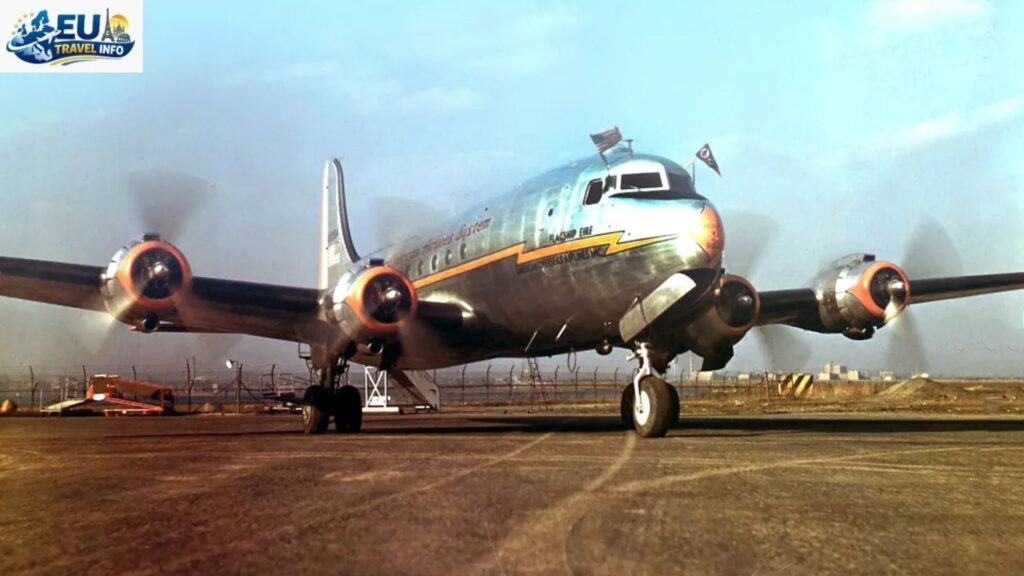
After World War II, things changed again. On top of that, new planes could land on the ground instead of the water. In October 1945, American Export Airlines started the first regular flights using DC-4 landplanes. These flights went from New York to England and took about 14 hours. By the late 1940s, many more airlines like KLM, Air France, and Swissair were also flying across the Atlantic.
Understanding the Machines
You might be curious about the tools these pioneers used. The NC-4 was a massive boat with wings. It had four Liberty engines. It could only go about 85 miles per hour. On the contrary, the Vickers Vimy used by Alcock and Brown was a bit faster. It was a biplane, which means it had two sets of wings.
Lindbergh’s plane was much simpler. The Spirit of St. Louis was made of fabric and wood. It did not even have a front window! Lindbergh had to use a periscope to see what was ahead of him. He did this so a big fuel tank could be placed in the front for safety.
The Lasting Impact
These flights changed the world forever. Before these brave pilots, it took five days to cross the Atlantic by ship. Now, you can do it in less than a day. The ocean is no longer a giant wall between us. Therefore, we owe a lot to the people who took those first risks in 1919 and 1927.
You should remember these names: Albert Read, Jack Alcock, Ted Brown, and Charles Lindbergh. They showed that the sky was not the limit. They turned a dangerous dream into a common way for you to see the world.
FAQ
When did flights from America to Europe start?
The very first flight with stops started on May 8, 1919, when the US Navy NC-4 mission left New York. The first nonstop flight happened just a few weeks later on June 14, 1915. Regular commercial passenger flights began on June 28, 1939.
Who was the first person to fly from America to Europe?
Albert Cushing Read was the commander of the NC-4, which was the first aircraft to complete the journey in May 1919. He led a crew of five other men.
When did United start flying to Europe?
The provided sources focus heavily on Pan American, American Export Airlines, and TWA as the early leaders in transatlantic travel. There is no specific mention in these sources regarding the date when United Airlines began its European service. You may want to verify this information from another source as it is not present in the current records.
When did the first plane fly from Europe to America?
The first east-to-west flight was performed by the British dirigible R-34 in July 1919. It flew from Scotland to Long Island, New York, in four days.
Concluding Words
In summary, the journey to connect America and Europe by air was a long and difficult one. It began with the US Navy NC-4 mission in May 1919, followed quickly by the Alcock and Brown nonstop flight in June of the same year. Charles Lindbergh made the trip famous with his solo flight in 1927, which led to the birth of the modern aviation industry. Finally, in 1939, Pan American opened the doors for regular travelers to cross the ocean in comfort. These historical facts show the amazing progress of human flight.