You want to plan a trip to Germany in 2026. It is a brilliant choice for your next big adventure. Germany offers a mix of old-world charm and modern energy. You will find steep vineyards, legendary castles on hilltops, and great food. The country is large.
Therefore, you need a solid plan to see the best parts without breaking your bank account. This guide provides every detail you need to create a perfect Germany Itinerary. You are about to see how to travel across this beautiful land with a focus on value and experience.
First Steps For Your Budget Trip

First of all, you must think about how you will move around. You do not need to rent a car in Germany. In fact, a car often adds stress. The train system is efficient and reaches almost every corner. You should look into a German Rail Pass. This pass allows you to travel throughout the country on all trains operated by Deutsche Bahn. A 10-day Germany itinerary by train is very easy to manage with this pass.
Numerical data helps with your budget planning. A 3-day second-class pass starts at 206 euros. If you travel as a pair, the Twin Pass is about 350 euros. Additionally, children from six to eleven years of age often travel for free with an adult. You should book your long-distance high-speed tickets online and in advance. Prices skyrocket the closer you get to your travel date. Plus, you can get a 10% discount on daily rates at A&O Hotels and Hostels if you have a rail pass.
Short Trips For Busy Travelers
Sometimes you only have a few days. A germany itinerary 3 days should focus on one region to save time. The Middle Rhine River Valley is a perfect choice. It is a UNESCO Heritage Site. You can base yourself in a town like Koblenz or a quaint wine village like Bacharach.
Bacharach is the quintessence of the Romantic Rhine. You will see green vineyards and a perfectly maintained fortification wall. You can visit the “Altes Haus.” It is the oldest house in town, built in 1368. Later, you might walk up to the Postenturm for panoramic views over the river.
If you have slightly more time, a germany itinerary 4 days allows you to add a visit to a castle. Stolzenfels Castle is a Gothic Revival masterpiece. Tickets cost approximately 5 euros. On top of that, you can visit Marksburg Castle. It is the only hill castle between Bingen and Koblenz that was never destroyed. Gradually, you will feel the history of the region come to life.
Expanding To A Full Week
A germany itinerary 5 days gives you room to see two major cities. You might start in Berlin and then take a train to Dresden. Berlin is a city of contrast. You can see the Brandenburg Gate and the Reichstag building in one session. However, do not forget the Berlin Wall Memorial and Checkpoint Charlie to understand the 20th-century history.
Dresden stands in contrast to the grit of Berlin. It is famous for Baroque architecture. You must see the Zwinger Palace and the Frauenkirche. Additionally, you can enjoy a relaxing cruise on the Elbe River.
For a germany itinerary 7 days, you should add Munich to the mix. Munich blends Alpine charm with world-class beer gardens. You can explore Marienplatz and watch the famous Glockenspiel. Finally, you should visit the English Garden or have a beer at the legendary Hofbräuhaus. This trio of cities provides a diverse flavor of German culture.
The Ultimate Ten-Day Adventure

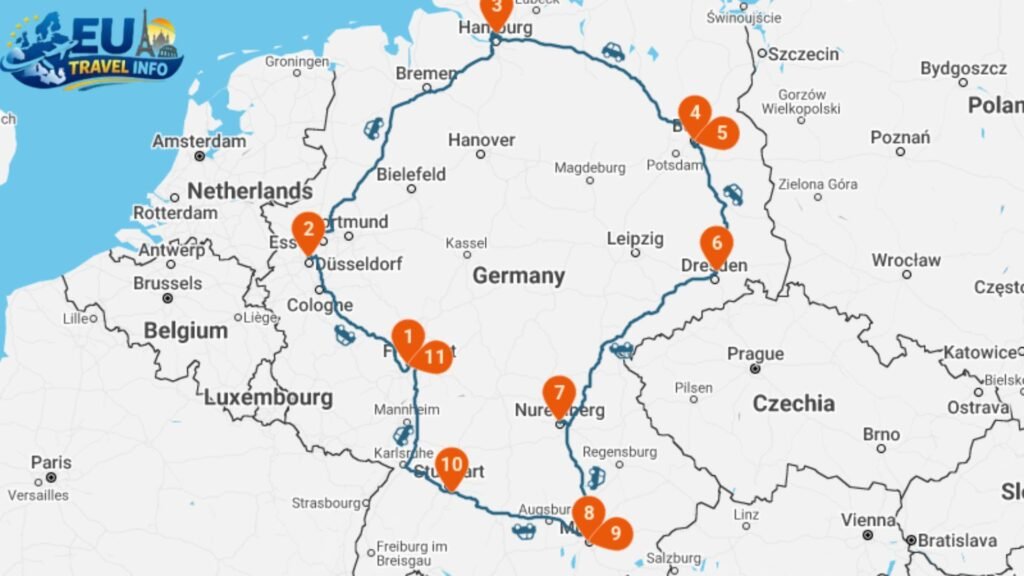
A germany itinerary 10 days is the most popular choice for travelers. It allows for a deep dive into the heart of the country. You might consider a germany itinerary 10 days from frankfurt. Frankfurt is a major flight hub. You can arrive at the airport and be in the city center in minutes.
First, spend a day in Frankfurt. The Römerberg is the prettiest part of the old town. Later, take a train to Nuremberg. Nuremberg is a walled city rich in medieval and World War II history. You can walk the town walls and visit the castle.
While you are in Nuremberg, take a day trip to Bamberg. It is only 40 minutes away by train. Bamberg is a UNESCO World Heritage town with medieval buildings and a bounty of canals. It is also a town of beers. There are 11 breweries in the town. You should try the Rauchbier. It is a unique smoked wheat beer.
Next, head to Munich for the final three days. One of those days must be a trip to Neuschwanstein Castle. It is the real-life fairy-tale palace that inspired Walt Disney. You can take a train to Füssen and then a bus to reach the castle. Plus, you might choose to ride a horse and carriage to the top.
The Full Two-Week Experience
If you have the time, a germany itinerary 14 days is the best way to see the country without stress. You can combine the big cities with hidden gems. First of all, spend time in Northern Germany. Hamburg is a maritime metropolis with a buzzing nightlife in the Reeperbahn district. You can visit the Fishmarket on a Sunday morning for a local experience.
Gradually move south through the Harz Mountains. Quedlinburg is a jewel with over 1,300 half-timbered houses. It is a living museum of the Middle Ages. Additionally, you can visit Goslar. The old town is a UNESCO World Heritage Site. You can even ride a mine train into the Rammelsberg Mine.
Later, head to the Black Forest. Triberg is home to the highest waterfalls in Germany. The water cascades down 163 meters. You will also see the world’s largest cuckoo clock in the nearby village of Schonach.
Finally, finish your trip in the Bavarian Alps. Mittenwald is a stunning town known for violin craftsmanship. It is called the “Village of a Thousand Violins”. You can take the Karwendelbahn cable car up to 2,244 meters for breathtaking views of the peaks. It is a perfect end to a long journey.
Budget-Friendly Tips For 2026
You should know that cash is still king in many parts of Germany. Much of the country prefers cold, hard cash. You will still find restaurants that say “Nur Bargeld” or “Only Cash”. Therefore, you should always keep a couple hundred Euro in your pocket.
Comfortable shoes are a must. People walk a lot in Germany. Your feet will thank you after a long day of sightseeing. Additionally, you do not need to worry about food if you are a vegetarian or vegan. Major cities like Berlin have a high number of plant-based options.
For accommodation, look for family-run hotels. In the Rhine Valley, the Sander Hotel in Koblenz is a stylish choice. In the wine village of Bacharach, the Rhein-Hotel Bacharach has been family-run for three generations. They serve regional food and local wines.
Off The Beaten Path Gems
If you want to avoid the crowds, look at the eastern borders. Görlitz is located on the German-Polish border. It is nicknamed the “Jewel of Germany’s East”. The city escaped damage during World War II, so the historical buildings are intact. It is so beautiful that many films, like “The Grand Budapest Hotel,” were filmed there.
Similarly, check out Zittau. It is a small town near the borders of Poland and the Czech Republic. It houses the “Great Lenten Veil,” a 15th-century tapestry that is over 8 meters high. From Zittau, you can take a steam-powered narrow-gauge railway into the mountains.
For nature lovers, Saxon Switzerland National Park is a must. It has unique sandstone rock formations and the famous Bastei Bridge. You can hike the Malerweg, or “Painter’s Way.” It is a 112-kilometer trail that follows the footsteps of Romantic artists.
Seasonal Planning
The best time to visit depends on your goals. For culture and sightseeing, May to October is ideal. The weather is mild-to-warm. You can enjoy outdoor cafés and beer gardens. However, the summer months of July and August are very busy.
If you love hiking, visit when it is warm. For skiing and Christmas markets, you must visit in winter. The ski season in the Alps runs from Christmas to the end of March. Christmas markets are magical. Cities like Nuremberg and Dresden have some of the oldest markets in the country. Every town feels different during the holidays.
Moving Between Cities
The train system makes moving easy. For example, the ride from Berlin to Hamburg takes about 1 hour and 45 minutes. Cologne to Frankfurt is only about 1 hour and 3 minutes. You should use the DB Navigator App to check schedules on the fly.
Most train stations are within walking distance of the city center. This saves you money on taxis or buses. Additionally, you can store your luggage in lockers at big train stations. You will need coins for these lockers. This is perfect for a quick stopover in a city like Schwerin on your way from Hamburg to Berlin. You can see the island castle and then hop back on your train.
Frequently Asked Question
How many days in Germany is enough?
A stay of 10 to 14 days is usually enough to see the major highlights and a few hidden gems. This allows you to explore at least three or four different regions without feeling rushed.
Is Munich or Berlin better?
It depends on your taste. Berlin is best for 20th-century history, street art, and a gritty, modern vibe. Munich is better for traditional Bavarian culture, beer gardens, and access to the Alpine mountains.
What to see in Germany in 7 days?
In one week, you can comfortably visit the “big three” cities: Berlin, Dresden, and Munich. This covers history, Baroque beauty, and Alpine charm.
What is the prettiest town in Germany?
Many travelers consider Bacharach on the Rhine or Quedlinburg in the Harz Mountains to be the prettiest. Both feature stunning medieval architecture and half-timbered houses.
Concluding Words
Your Germany Itinerary for 2026 is the key to an amazing and budget-friendly trip. By using the train system and focusing on a mix of major cities and hidden gems like the Middle Rhine or the Harz Mountains, you can see the best of German culture.
Remember to book your rail pass early and keep some cash on hand for the best experience.