Pet Friendly Villas in CyprusI love to travel the world with my dog, and I recently spent a long time exploring the Mediterranean. I wanted to find the best Pet Friendly Villas in Cyprus. I asked myself often, is cyprus dog friendly? I discovered that this island is a paradise for people who travel with pets, but you must know the rules first. I found many dog friendly villas cyprus during my search. I even compared these spots to a pet friendly villa near mumbai I saw online once. However, the charm of the Cypriot villages won my heart. I searched for pet friendly villas near me and realized that Cyprus offers thousands of options. I once thought about pet friendly villas in igatpuri for a short trip, but I needed the sun of the Mediterranean. Therefore, I packed my bags and my dog for a grand tour.
First of all, you must plan your trip at least three months before you leave. I had to talk to my vet about a timeline. I started with a 15-digit microchip for my dog. This chip must be ISO 11784 or 11785 compliant. The chip must go in before the rabies shot. I waited 21 days after the first rabies shot before we could fly. Later, I obtained an Animal Health Certificate within 10 days of our arrival. I also informed the airport vet in Larnaca 48 hours before our flight. On top of that, I made sure my dog was not a banned breed. Cyprus does not allow Pit Bulls, Japanese Tosas, Dogo Argentinos, or Fila Brasileiros.
I chose Cyprus Airways for our flight. They allow dogs in the cabin if they are small. My dog weighs less than 8 kilograms, so he stayed with me. The total weight with his carrier was under 10 kilograms. The carrier was 45 by 35 by 20 centimeters. It was a tight fit. But he was comfortable. I paid 50 euros for a short direct flight. For longer flights, the price is 60 euros. Transfer flights cost 100 euros for the cabin. If your dog is big, he must go in the hold. Hold prices range from 60 to 120 euros depending on the route. Additionally, you must book the pet ticket 24 hours before you fly.
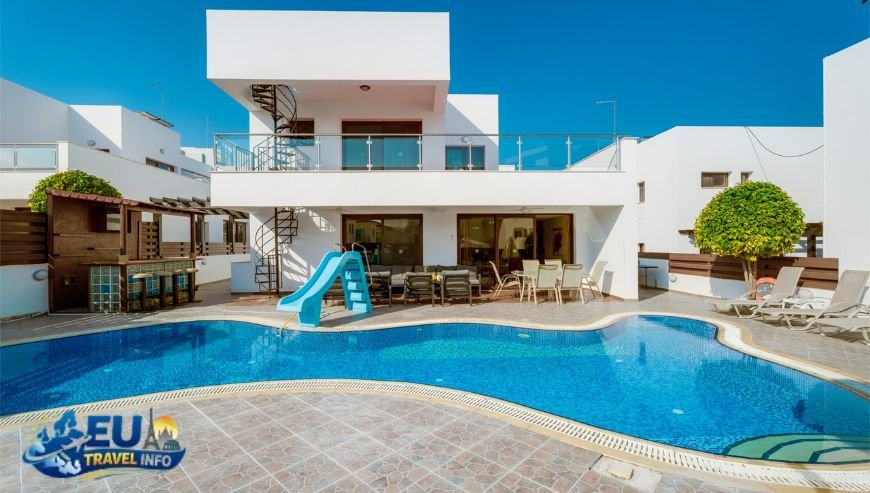
First of all, Paphos is a major hub for pet friendly villas cyprus. I found over 6505 places to stay in this region. Over 494 of these are pet-friendly rentals. Prices in Paphos start as low as US $28 per night. However, the average price for a nice place is around US $274 a night. I stayed in a beautiful stone villa in Pegeia for US $170. It had a large pool. Plus, the owner let me use a car for free. I also saw a luxury villa in Peyia Town for US $1,527 a night. It had a jacuzzi and panoramic sea views.
There are many neighborhoods to pick from in Paphos. Melanos has 2635 properties. Pegeia has 1105 properties. I liked the quiet feel of Kissonerga which has 115 properties. I also checked out dog friendly hotels cyprus in the area. Some hotels have weight limits of 20 kilograms. They often charge 25 euros extra per day. Therefore, a villa is usually a better deal for a long stay.
Gradually, I moved to the East to see Protaras. This area has some of the best dog friendly villas cyprus. Seafront Protaras offers villas with secure outdoor areas. They have fenced gardens and enclosed terraces. This is great for safety. I do not have to worry about my dog running away. The villas have tile floors. This makes cleaning up easy. These villas are only 200 meters from Fig Tree Bay. That beach is ranked number three in the world. I found villas there that sleep up to 28 people. Superior villas there have saunas and jacuzzis.
Later, I explored the Troodos Mountains. I wanted a cool breeze in the summer. There are 66 pet-friendly places in Troodos. I saw a mountain retreat in Pano Platres for US $1,170. It had amazing views. Another villa in Prodromos was US $510. It had a fireplace and a sauna. The average price in the mountains is US $313 a night. The high temperature in the mountains is around 96 degrees Fahrenheit in August. At night, it drops to 65 degrees. This is much cooler than the coast.
I love the “Agrotourism” movement in Cyprus. This means you stay in restored traditional houses in small villages. These houses are licensed by the Cyprus Tourism Organisation. I stayed in Agios Theodoros Cottage in Choulou Village. It had stone walls and a fireplace. The owner, Sylvia, made me homemade breakfast. Another great spot was the House of Rigena. It is over 140 years old. It has a large stone-paved courtyard with flowers.
In Goudi Village, I found Leonidas Village Houses. It is a complex of five houses with a common pool. The view of the valley is panoramic. I also liked Spanos House because it sits in an orange orchard. You can pick succulent oranges right from the trees. In Kathikas, I found Loxandra’s House. It has three apartments and a studio. The stone courtyard has a unique play of light and shadows.
Gradually, I visited Arsorama in Arsos Village. This is a traditional home with four independent apartments. The apartments connect to a large internal garden. At that time, the garden was a place where village women would embroider together. Now, it is a peaceful spot for travelers. I also recommend Vouni Lodge in Vouni Village. It is over 200 years old. It has a private garden with sun beds. Plus, it is very pet friendly.
In the Larnaca region, I stayed at Aunt Maria’s in Pano Lefkara. It is a recently renovated stone house. The garden is colorful. It has three one-bedroom apartments. I also liked the Red Blue Door in the same village. The Red Door house has a private pool and a steam room. The Blue Door house is better for families. On top of that, the village is famous for its lace and silver.
Finally, I visited Kalopanagiotis in the Nicosia region. This mountain resort has sulphur springs. I stayed at Agios Andronikos Apts. It was built in 1890. The apartments overlook the Setrachos River. I also saw Hani Chrysomilou. It was an old inn founded in 1900. Now it is a luxury house with an indoor jacuzzi and a fireplace. The mountain views are breath-taking.
First of all, you must know the beach laws. Most public beaches do not allow dogs. If the beach is “organised,” your dog is banned during the day. An organised beach has sunbeds, umbrellas, or lifeguards. You can only walk your dog there between 8:30 PM and 6:00 AM. You can also go there between November and March. If you break this rule, you might pay an 85 euro fine.
However, there are seven official dog beaches in the South. Kasianes Beach near Larnaca is very good. It is a sandy beach. The water is clean and shallow. Steratzia Beach in Kato Pyrgos is secluded. You must ask a local for directions because it is not on most maps. Karavopetra Beach in Limassol is easy to reach by car. It has plenty of sand and calm water.
On the contrary, some dog beaches are not very nice. Pitili Beach is stony and rocky. The sea there can be dangerous. Prolimnos Beach is also difficult. The road is a dirt track with potholes. The water is very deep with large waves. I consider it dangerous for swimming. Acheleia Beach near Paphos Airport is safe but has pebbles. It is good for dogs but not great for humans to swim. Gliki Nero B in Paralimni is very small and next to the buffer zone.
I found that private restaurants are much more welcoming than public beaches. In Nicosia, I went to Moondog’s Bar & Grill. They accept dogs, but there are many cats in the area. I also visited a big coffee house in Engomi. They offer water and treats to dogs. Other spots in Nicosia include The Workshop and Golden Tiger.
In Limassol, Shakespeare Gastropub is a good choice. I also liked The Swan Pub in Akrotiri. They have a special “Dog Bar” corner outdoors. In Larnaca, Vibes Cafe Bar is very friendly. Refuel ice creamery even offers special ice cream for dogs.
Paphos has many pet-friendly spots. Palia Ilektriki in the Old Town has a serene courtyard. Koutourou Ouzeri encourages owners to bring their dogs to the terrace. Baracas Lounge in Chloraka has shaded areas designed for dogs. Ouzeri Restaurant at the Almyra Hotel allows dogs under 10 kilograms. Oniro by the Sea in Peyia genuinely welcomes dogs. It is next to a shipwreck and offers great views. Always keep your dog on a leash and ensure they are well-behaved.
You must legalize your dog once you arrive. You have to visit a local vet to get a microchip certificate. Then, you go to the State Veterinary Service to register your dog in the central register. Finally, you go to your local municipality for an annual license. You must be at least 16 years old to own a dog there.
The license costs 20.50 euros per year for most dogs. However, “dangerous” breeds cost 170 to 171 euros. These breeds must also be sterilized. You have to renew this license every year by the end of January. You also need to put up a “Beware of Dog” sign with a picture at your gate.
The fines in Cyprus are very high. If you do not have a license, the fine is 200 euros. Walking your dog without a leash in public costs 300 euros. If you do not clean up poop, you pay 300 euros. No caution sign on your property costs 50 euros. If you have a dangerous breed that you did not declare, the fine is 1,000 euros. Walking a dangerous breed without a muzzle or leash costs 2,000 euros. Therefore, you must follow every rule carefully.
Additionally, travel within the island can be hard without a car. Intercity buses only allow small pets under 8 kilograms. They must be in a carrier no larger than 40 by 25 by 25 centimeters. Only one pet is allowed per bus. It is up to the driver to let you on. Taxis are more flexible, but you must book them in advance. Big dogs in taxis must be muzzled and on a leash. I highly recommend renting a car if you have a medium or large dog.
The Mediterranean climate is beautiful but has risks. Sand flies are very common on the island. They carry a parasitic disease called Leishmaniasis. It is a silent threat. Studies show that up to 14.9 percent of dogs in Cyprus have antibodies for it. You must use repellent collars like Scalibor. You should also use spot-on treatments from a vet.
Other dangers exist too. Poisoning is a serious problem on expat forums. Some people scatter poisoned bait to kill stray animals. Your pet can accidentally eat it. You must be very vigilant when you walk your dog. In rural areas, there is a risk of snakebites. Overheating is also a danger in the long summer. Always carry water. Do not walk your dog during the hottest hours of the day.
Fortunately, the vet care in Cyprus is very high. There are many modern clinics with 24-hour emergency services. I found clinics in every major city. Healthy Pet Veterinary Clinic is in Limassol. CYVETS is a big center in Paphos. Vet Cross is in Nicosia. Many vets speak English and Russian.
Cyprus has a lot of animals. The sheep population is 128,545. There are 72,662 goats. The island also has 81,314 bovines. The poultry broiler population is over 12 million. Cyprus is officially free of many diseases. It is rabies-free. It is also free of Foot and Mouth Disease and Brucellosis. These stats show that the Veterinary Services work hard to keep the island safe.
Northern Cyprus is a different story. It is not under the effective control of the Republic of Cyprus. The movement of live animals through the ceasefire line is prohibited. Brucellosis still exists in the North. If you go to the North, you must follow stricter rules. You need a mandatory Import Permit. You also need a rabies antibody titer test. This test is required for dogs from any country entering the North. Without it, your dog goes into quarantine for one to six months. You have to pay all the expenses.
Gradually, I realized that the North is a growing market for pet owners. Many expatriates and digital nomads move there. There are limited pet-friendly housing options, so demand is high. Places near green spaces and beaches in Kyrenia are popular. Real estate investors now focus on adding fenced yards and durable flooring to attract pet owners.
Cyprus is a land of contrasts for dog owners. You get amazing weather and a rich social life. But you must be very responsible. You must follow the import laws perfectly. You have to register your dog immediately. You must obey leash laws even if others do not. You have to protect your pet from sand flies every day. Plus, you must respect your neighbors and their flower beds.
I loved my stay in the Pet Friendly Villas in Cyprus. I found that pet friendly hotels cyprus are okay for short trips, but the villas are better for the soul. I stopped searching for pet friendly villas near me because I found a home in the Cypriot hills. I stopped thinking about that pet friendly villa near mumbai or those pet friendly villas in igatpuri. The island of Aphrodite is the best place for a mature traveler and their best friend.
I remember sitting on the terrace of a 200-year-old house in Kalopanagiotis. The sound of the river was peaceful. My dog was sleeping at my feet. The smell of jasmine was in the air. I had a glass of Commandaria wine, which is one of the oldest in the world. I felt free. “I believe in nothing, I am afraid of nothing, I am free” is a quote I saw in a villa called Kostaris. That is exactly how I felt.
If you are a prepared and responsible owner, you will have a wonderful life here. The standard of living is high. The people are hospitable. They will treat you like family. They might even give you a feast of local delicacies. You will make many good friends before you leave. Cyprus is truly a special place. It has a history that goes back 10,000 years. You can ski in the mountains in the morning and sunbathe on the beach in the afternoon during January and February.
FAQ
Is Cyprus pet friendly?
Yes, Cyprus is considered pet-friendly, particularly regarding private establishments like cafés, bars, and restaurants that often welcome dogs on their terraces. However, public spaces like organized beaches are generally restricted.
Can I take my dog to live in Cyprus?
Yes, many people relocate to Cyprus with their pets. You must follow specific import regulations, which differ between the Republic of Cyprus (South) and Northern Cyprus, and you are required to register your dog with the local municipality to obtain an annual license.
Is Cyprus good for dogs?
Cyprus offers a sunny climate and numerous nature trails and scenic coastal routes for dogs to enjoy. While the social environment is welcoming, owners must actively manage risks such as high summer temperatures, leishmaniasis, and potential poisoning in certain areas.
Does Cyprus Airways allow dogs in cabin?
Yes, Cyprus Airways allows small cats and dogs in the cabin, provided the pet weighs no more than 8 kg (or 10 kg including the carrier). Note that pets are not allowed in the cabin on flights to the United Kingdom or Dubai.
How do I bring my pet to Cyprus?
To bring a pet to the Republic of Cyprus, you must ensure it has a 15-digit ISO microchip, a valid rabies vaccination (administered at least 21 days before travel), and either an EU Pet Passport or an Animal Health Certificate. You must also notify the District Veterinary Officer at your point of entry at least 48 hours before arrival.
Can dogs go on beaches in Cyprus?
Dogs are banned from most public “organized” beaches, and owners found with dogs in these areas may face an €85 fine. However, there are seven officially designated dog beaches on the island where pets are allowed to swim.
What pets are legal in Cyprus?
Dogs and cats are common legal pets, though the Republic of Cyprus strictly prohibits the import of specific dog breeds: Pit Bull Terriers, Japanese Tosas, Dogo Argentinos, and Fila Brasileiros.
How much to fly my dog to Cyprus?
On Cyprus Airways, flying a pet in the cabin costs between €50 and €100, while transport in the aircraft hold costs between €60 and €120, depending on the route and flight duration.
What to avoid with dogs?
Avoid walking dogs during the hottest part of the day to prevent overheating. You should also be vigilant about poisoned bait scattered in some areas and use repellent collars to protect against sand flies, which transmit leishmaniasis.
Which beach is best for dogs?
Spyros Beach (Kasianes) south of Larnaca airport is highly recommended as it is sandy and features clean, shallow waters. Karavopetra Beach in Limassol is another good option with plenty of sand and calm waters.
Concluding words
Cyprus offers a wide array of pet-friendly villas ranging from luxury seafront properties in Paphos and Protaras to traditional stone houses in rural villages. These accommodations often feature fenced gardens, private pools, and easy access to nature trails, ensuring a comfortable stay for the whole family.
While navigating strict public beach laws and health risks requires preparation, the island’s welcoming private establishments and high standard of veterinary care make it an excellent destination for responsible pet owners.