I have spent years traveling across borders with my four-legged friends. It is my favorite way to see the world. If you love travel as much as I do, you know that a trip feels incomplete without a wagging tail. Europe is the absolute best place for people like us. The Pet-Friendly Culture & Rules in Europe make it a dream destination for mature travelers who want comfort and companionship.
The dream life. Perfect weather. A happy dog by your side.
I have visited over 30 countries with my pups. Every border crossing taught me something new. Some countries treat dogs like royalty. Others have strict rules you must follow. In this guide, I will share everything I have learned about the 15 best pet-friendly spots in Europe. I will also explain the legal bits, the transport tricks, and the unspoken rules of etiquette.
The Legal Essentials: Passports and Health Checks
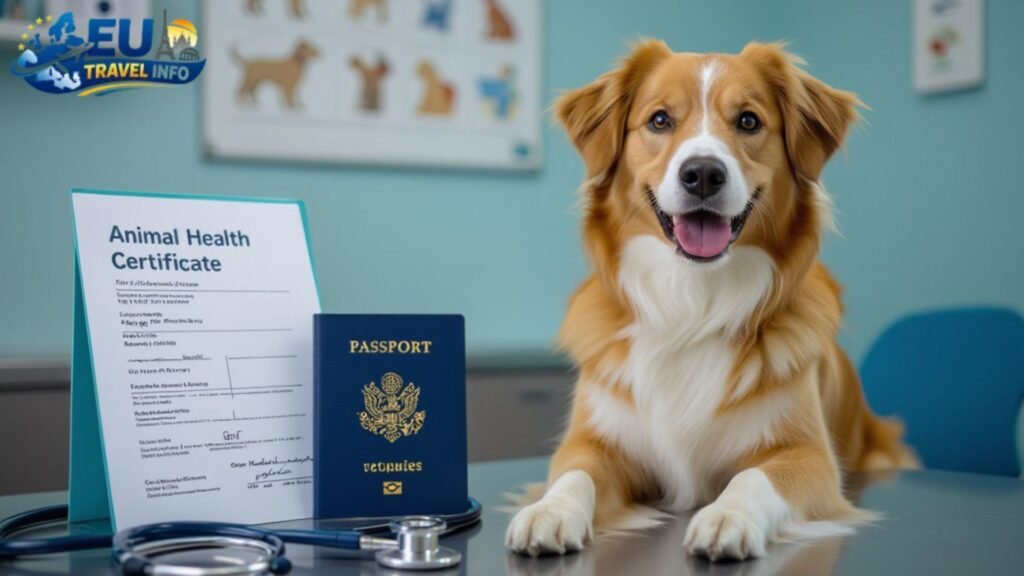
First of all, you must understand the paperwork. Your dog needs an identity. The International pet passport is the gold standard here. If you are a resident of the European Union, you can get an EU Pet Passport from any authorized vet. It is a simple blue book. It contains your pet’s microchip code and rabies vaccination records.
How long does a dog passport last? It is valid for the life of your pet as long as the rabies vaccinations are kept up to date. I always make sure my vet records the booster shots before the old ones expire. If you let a vaccination lapse, you must wait 21 days after the new shot before you can travel again.
If you are coming from outside the EU, like the United States or the United Kingdom, things are different. You will need an EU Animal Health Certificate (AHC). An official state vet must sign this document. You must do this no more than 10 days before you arrive in Europe.
The Animal Health Certificate cost can be a bit of a shock. In the United Kingdom, it usually costs between £100 and £200. You might also find an Animal health certificate PDF online to see what the form looks like, but a vet must fill it out. Additionally, your dog must have a microchip that meets ISO standards 11784 or 11785.
Specific countries have extra rules. If you go to Finland, Ireland, Malta, or Norway, you need the Anti Echinococcus treatment pet passport entry. A vet must give this tapeworm treatment between 24 and 120 hours before you enter the country.
Understanding Breed Bans and Restrictions
You must also be aware of Breed Bans. Public safety is a big deal in many European regions. Regulation (EU) No 576/2013 focuses on rabies, but individual countries have their own laws about “dangerous” dogs.
Germany, for example, does not allow the import of Pit Bull Terriers, American Staffordshire Terriers, or Bull Terriers. France is even stricter. They have “Category 1” dogs that are not even allowed to pass through the country in transit. The United Kingdom recently added the American XL Bully to its banned list in 2024 after a rise in serious incidents.
Before you book a flight, check if your dog’s breed is restricted. Often, these laws are based on physical features rather than just pedigree. It is a difficult reality for some owners. “Unsure if your dog’s breed is banned?” You should ask a pet travel specialist before you go.
Transport: Taking Dogs Abroad by Plane and Beyond
Taking dogs abroad by plane is a common choice for long distances. If your dog is small, you are in luck. Many major airlines allow a Flying Pet-Friendly Culture & Rules in Europe if the total weight of the dog and the carrier is under 8 kilograms.
Lufthansa, KLM, and Air France are my top three favorites. They have well-trained staff who know the rules. Vueling is also a great choice for budget travel because they allow pets in the cabin for a fee of about €50. However, budget giants like Ryanair and Wizz Air do not allow any pets on board.
Large dogs must usually travel in the hold. It is a temperature-controlled, pressurized area. Lufthansa is famous for its “Pet Lounge” in Frankfurt, which is great for connecting flights.
How to get a dog to Europe without flying? If you are coming from the United Kingdom, the Eurostar train is a no-go for pets. Instead, use Le Shuttle or a ferry. Le Shuttle allows your dog to stay in your car during the 35-minute trip under the sea. It costs about £23 per pet each way.
Ferries are another wonderful option. Some lines, like Stena Line, even offer pet-friendly cabins where your dog can sleep on the bed with you.
The 15 Best Pet-Friendly Destinations in Europe
I have ranked these based on my personal experiences and local laws. Some of these countries will surprise you.
1. Italy: The King of Dog Love

Italy is a paradise for dog owners. I give it a perfect 10 out of 10. You will see dogs in restaurants, cafes, and even high-end boutiques. I remember a trip to a fancy restaurant in Lucca where nobody even blinked when a large dog walked in. 79% of Italian pet owners consider their pets family members. This number rises to 85% among millennials. It is the most inclusive place I have ever been.
2. Germany: Organized Affection
Germany is another 10 out of 10 for me. It is extremely organized. Dogs are welcome in most shopping malls and restaurants. There is a catch, though. You must pay a dog tax called Hundesteuer if you live there. It can cost between €60 and €900 per year depending on the breed and city. Also, almost every owner has dog liability insurance. It is just the responsible thing to do.
3. France: Sophisticated Dining
France is famous for the “café dog”. Most restaurants and bars love dogs. Waiters often bring a bowl of water before they even take your order. I give France a 9 out of 10. The only reason it is not a 10 is because many public parks in Paris do not allow dogs. However, the coastline is very welcoming.
4. The Netherlands: Bike-Basket Pioneers
The Dutch are masters of pet integration. You will see dogs in the front baskets of bicycles everywhere. Amsterdam is home base for many travelers because dogs are welcome on all public transport. The Netherlands even declared themselves “stray-free” after a century of hard work. It is a 10 out of 10 destination.
5. Switzerland: The Outdoor Adventurer
Switzerland is perfect for active travelers. You can take your dog on almost any hike or train. They take pet ownership very seriously. First-time owners are even encouraged to take training courses. The views of the Alps are better when you share them with a furry friend.
6. Austria: The Mountain Explorer
Austria follows similar rules to Switzerland. I give it a 9 out of 10. Dogs are welcome in most eateries. The only downside is that some beautiful parks in Vienna have “no dogs” signs. Still, the mountain trails are endless and very dog-friendly.
7. Romania: The Ownership Leader
Romania might surprise you. It actually ranks #1 in Europe for pet ownership. 48% of households own cats and 45% own dogs. There is a huge shift happening here. Public attitudes are changing from “guard dogs” to “family members”. More pet-friendly cafes are opening in cities like Bucharest every day.
8. Czech Republic: The Dog Republic
The Czech Republic has earned a funny nickname: “The Dog Republic”. There are more dogs than children under age 10 in this country. You can take your dog into most pubs and even some castles. Prague is one of the easiest cities to navigate with a pet.
9. Luxembourg: The High-Standard Haven
Luxembourg recently updated its laws to recognize animals as sentient beings with rights. Public transport has been free since 2020, and that includes dogs. It is a small but very wealthy and welcoming country for pets.
10. Poland: The Cultural Includer
Poland has shifted its view of pets over the last 20 years. Now, you can take your dog to some movie theaters and museums. Major cities like Krakow have expanding dog parks. 49% of Polish households have a dog. It is a thriving pet culture.
11. Slovenia: The Green Haven
Slovenia is a hidden gem. It is one of the most pet-loving countries in the Balkans. Over half of the hotels in the capital, Ljubljana, are pet-friendly. I give it a 9 out of 10. The nature is stunning, and dogs are welcome on most trails.
12. Belgium: The Waffle-Sharing Friend
Belgium is a dog-lover’s paradise. Most restaurants welcome dogs and offer them water. I have taken my dogs on Belgian trams and trains with zero issues. It is a very relaxed atmosphere.
13. Sweden: The Nordic Paradise
Sweden has some of the highest animal welfare standards in the world. Over 90% of pets are insured. Some restaurants even have “dog sections” so people with allergies can sit elsewhere. It is a very balanced way of living.
14. Estonia: The Modern Nomad
Estonia is very forward-thinking. In the capital, Tallinn, dogs are welcome in many restaurants and even some museums. Public transport allows pets, and the city is very clean and safe.
15. Portugal: The Laid-Back Coastline
Portugal is a bit more complicated. In the past, it was less friendly, but things are changing. Dogs are allowed in restaurants about 50% of the time now. The coastline is beautiful for walks, though some beaches have bans during the summer.
Public Transport: Trains and Subways
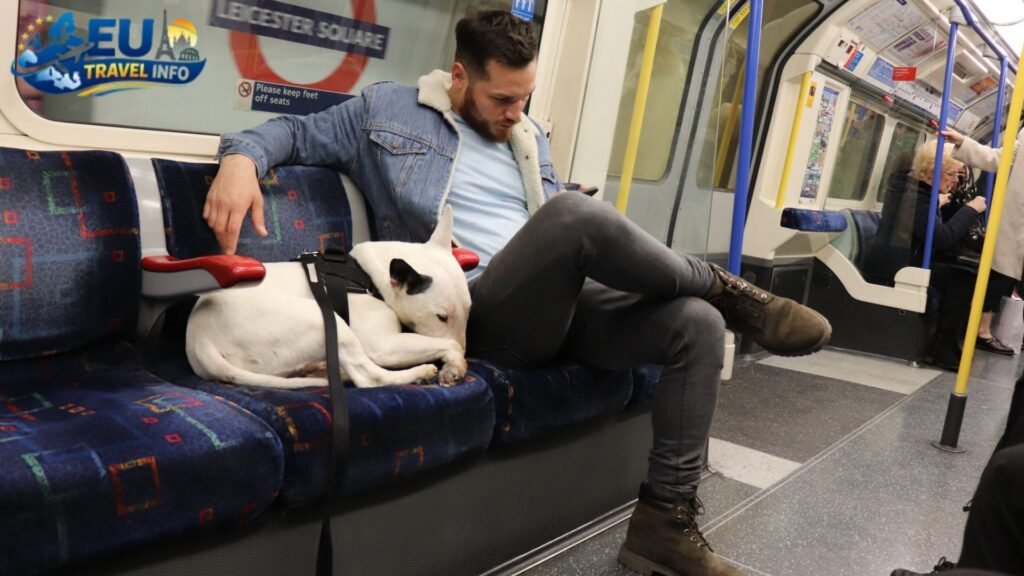
Train travel is the best way to see Europe with a dog. It is much less stressful than flying. Most rail operators allow pets, but the rules vary.
First of all, small pets in carriers usually travel for free. Carriers should be around 45 x 30 x 25 cm. Larger dogs usually need a ticket. In Germany and Austria, you pay a “child rate” or half-price for a larger dog.
In Italy, small dogs in carriers are free on Frecciarossa trains. Larger dogs get a 50% discount. Similarly, in France, SNCF charges a flat fee of about €10 for pets.
One important rule: larger dogs must be leashed and wear a muzzle on almost all European trains. Even if your dog is the sweetest soul, carry a muzzle in your bag. A conductor might ask you to put it on at any time.
Additionally, Pet-Friendly Culture & Rules in Europe. Pets, are usually not allowed in the restaurant cars of trains. Keep your dog at your feet or under your seat so you do not block the aisle.
Dining Etiquette: How to Be a Good Guest
Dining out with your dog is a privilege. You must follow the unspoken rules to keep the culture alive.
- Know your dog: If your dog barks at strangers or is high energy, leave them at the hotel.
- Call ahead: Even if a place says it is dog-friendly, ask for a patio or corner table.
- Keep them on the floor: Never let your dog sit on a chair or your lap at a restaurant. It is a hygiene issue.
- Do not feed from the table: Other diners might find it gross. Plus, restaurant food can be unhealthy for pets.
- Bring your own bowl: Do not ask the server to use a human plate for your dog. Carry a collapsible water bowl in your bag.
A well-behaved dog is a “silent” member of society. In Germany, there is a strong social expectation that dogs should be impeccably trained and quiet. If your dog acts like a “tiny human” and begs for food, people might laugh, but it is better if they remain calm and aloof.
Managing Health and Emergencies
Handling health issues abroad is stressful. I always research local vets before I arrive at my destination. Save the numbers for 24/7 emergency hospitals in your phone.
Additionally, building a pet emergency kit is a must. Include:
- A copy of vaccination records.
- Prescription medications.
- First aid items like bandages and antiseptic wipes.
- A thermometer and tweezers.
Carry pet insurance that covers international travel. Companies like ManyPets or Petplan offer EU travel cover as standard. This can save you thousands if an emergency happens. Gradually, you will get used to the different vet systems. Most European vets speak some English, especially in the big cities.
Frequently Asked Questions
What is the most pet friendly country in Europe?
I have found that Italy, Slovenia, and Germany are top choices for every dog lover. One traveler in the sources even calls Slovenia the most dog friendly country they have ever visited. In Italy, people treat dogs like royalty, and you can bring them into almost any restaurant. France is also a great spot where pets are legally seen as living beings with feelings rather than just property.
Which country is the most pet friendly?
This often depends on what you want for your pet. Slovenia is a favorite for those who love nature and open trails. However, Italy is widely loved because dogs are allowed in high-end boutiques and even some grocery stores. Germany is also very inclusive but has more specific rules for owners to follow.
What is the pet culture in Germany?
The pet culture in Germany is described as organized affection. People view dogs as life partners and treat them with a lot of respect. There is a strong social contract here. Additionally, owners must register their pets, pay a dog tax, and often have liability insurance. You will see dogs in malls and restaurants, but you must keep them out of supermarkets and bakeries.
Which country in Europe has the most pets?
Romania ranks as the number one country for pet ownership in Europe. In this nation, 48 percent of households own cats and 45 percent own dogs. This is the highest combined rate on the whole continent. Poland also has very high rates, with 49 percent of homes owning a dog.
Is Italy a dog friendly country?
Yes, it is one of the best in the world. 79 percent of Italian owners consider their pets to be family members. You can take your dog to most eateries and hotels without any extra fees. People are very relaxed and happy to see your pet enjoying public life with you.
Why are dogs in Germany so well behaved?
Dogs in Germany are very calm because training is a major part of the culture. Many owners attend intensive obedience schools like Schutzhund to ensure their pets follow commands perfectly. There is also a high expectation that dogs remain quiet and “silent” when they are in public spaces like restaurants.
Conclusion
Travel in Europe is a wonderful way to bond with your pet. I have seen that Italy, Germany, and Romania offer some of the most inclusive cultures for animals. You must handle the legal paperwork like the EU Pet Passport or the Animal Health Certificate before you start your tour. Always respect the local rules about muzzles on trains and dog taxes in specific cities. A well-prepared journey leads to a happy tail.
Final Thoughts on Your European Adventure
Traveling with a dog in Europe is rewarding beyond words. It forces you to slow down. You see the parks and the quiet streets. You meet locals who want to pet your dog. It is a bridge between cultures.
First of all, get the paperwork right. Later, pick your transport. Finally, enjoy the freedom of the open road or the high-speed rail. Italy, Germany, and the Netherlands will welcome you with open arms.
The leash is not just a tool for control. It is a symbol of a shared life. Whether you are drinking wine in a French café or hiking the Swiss Alps, your dog makes the journey better.
A well-prepared traveler and a well-behaved dog are like a perfectly matched pair of shoes. They take you further than you could ever go alone. Be that pair. Explore Europe. Make memories that last a lifetime.