I have traveled to Italy on three different trips with my dog, and I can say it is one of the most welcoming places in Europe. Every time I go, I find more reasons to love it. Italy is truly hands-down one of the best spots for anyone who loves their furry friend. If you are a mature traveler who wants a mix of luxury and comfort, you have come to the right place. A dream vacation with your pup. Beautiful hills. Ancient ruins. Great pasta.
When I first thought about dog friendly holidays in italy, I was a bit nervous. How would I find dog friendly accommodation in italy? Would restaurants turn us away? However, my worries disappeared as soon as we landed. Italians love dogs. Most people treat them like family members. In this guide, I will share everything I have learned about finding pet friendly rentals in italy. I will also talk about the rules for trains, planes, and the best dog friendly villas in tuscany.
First Things First: The Planning Stage
Before you pack your bags, you need to handle the paperwork. It is not as hard as it sounds. If you are coming from the EU, you just need a microchip, a pet passport, and a valid rabies vaccine. Additionally, if you are coming from the United States, things get a bit more detailed. Your vet must use an ISO-compliant microchip. This chip usually has 15 digits. First of all, the microchip must go in before the rabies shot.
The rules for rabies vaccines are very specific. The EU considers the first shot after the microchip as a “primary” vaccine. For pets from the US, this shot is only good for one year. You must wait at least 21 days after this shot before you travel. Plus, you must get a “booster” shot within 12 months to keep it valid for a longer time. Your health certificate must be signed by a USDA-accredited vet and then stamped by the USDA.
Once you arrive, you might need to register your pet. In Italy, the law says pets must be in the Italian ASL system. If you move there or stay a long time, you have 90 days to register. If you do not do this, you could face a fine of 200€ or more. Gradually, you will get used to these rules. A small price for a great trip. Simple rules. No stress.
How to Get to Your Italian Villa
You have a few choices for travel. If you drive from another EU country, it is very easy. However, if you fly, you must check the airline rules. Some airlines allow small dogs in the cabin if they fit in a carrier. The carrier should be about 70 x 30 x 50 cm. On top of that, new rules from June 2025 allow some bigger dogs in the cabin if the total weight does not go over the limit.
If you have a large dog and plenty of money, you can look at private jets. I saw people on Reddit talking about K9 Jets and Bark Air. A seat from New York to Paris or Milan can cost between $8,500 and $11,000. Similarly, some people use a Facebook group called “Chartered Air Travel With Pets” to share the cost of a private jet. It is expensive. Therefore, most people still use regular flights.
One traveler, Francesco Pio Mancini, shared his story about flying with his 35-kilo Golden Retriever, Leon. He used a special kennel with a double lock and aluminum sides for safety. He had to drop Leon off at a special check-in area one hour before the flight. Finally, they landed and Leon was happy to run around in the sun.
Finding the Perfect Pet Friendly Accommodation in Italy
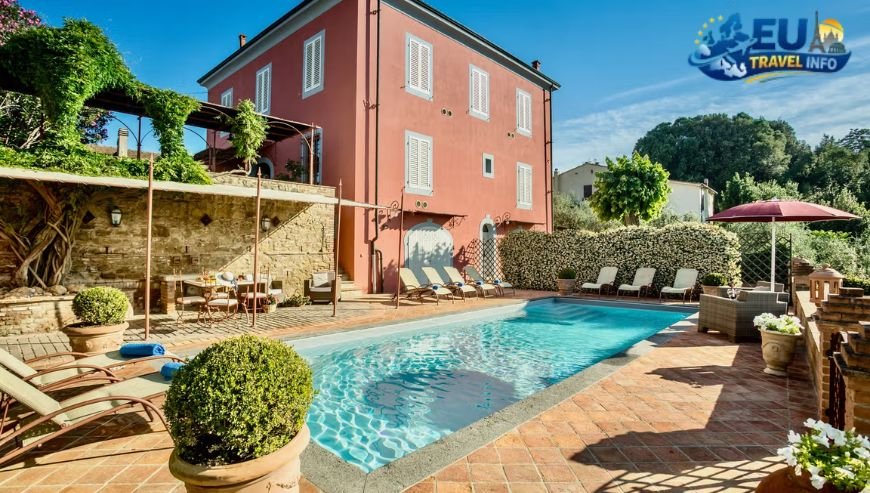
When I look for a place to stay, I want space. I want a garden. I want pet friendly villas in italy. There are so many great options. I once spent time looking for pet friendly villas in igatpuri, but the luxury of the Italian countryside is on another level.
If you want the best of the best, look at Home in Italy. They have amazing stone farmhouses. For example, Arcelle is a villa on the border of Tuscany and Umbria. It has old oak beams and stone fireplaces. It can sleep 12 people. Additionally, they have a villa called Peonia in Umbria. It has a fenced garden that is 7.5 hectares big. That is a lot of room for a dog to run! Plus, it has a private tennis court and a sauna.
To Tuscany is another great company. More than half of their properties are pet friendly accommodation in italy. They allow one dog up to 30 kilograms by default. If you have more than one dog, you just have to ask them. Therefore, it is a very easy process.
My Favorite Dog Friendly Villas in Tuscany
Tuscany is the heart of any Italian tour. I love the rolling hills and the wine. Pet friendly villas in tuscany are everywhere. Here are a few I recommend:
- Poggio Tondo: This villa is in Chianti. The entire property is fully fenced. You can let your dog roam without a worry.
- Colle Santa Cristina: This one is in the Garfagnana region. It has huge gardens and views of mountain villages. It is near the famous Devil’s Bridge.
- Villa Rosabella: This is part of a small hamlet. Each villa has its own fenced garden. It is only 1 km from Brolio Castle.
- Sassolaia: A peaceful spot in Chianti with a very well-kept garden.
- Poggio Lungo: This is a giant villa with 9 bedrooms. It is perfect for a big family reunion with multiple dogs.
Though most villas are very welcoming, they do have rules. You must keep your dog out of the pool. The fur can mess up the filters. Also, you should keep them off the sofas and beds. On top of that, some places like Villa Miragalli are very strict. They require an extra 500€ deposit for pets. They even say the dog must sleep outdoors. I always check these rules before I book. Clear rules. Happy owners.
Getting Around on Trains and Buses
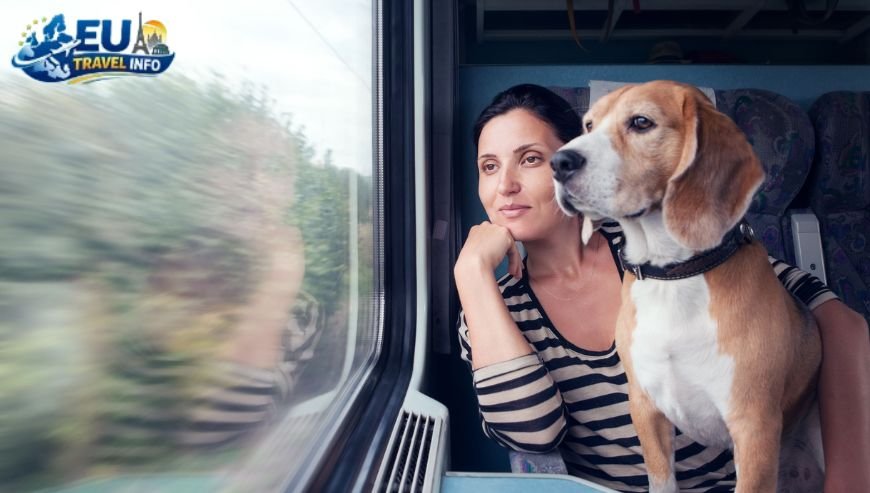
I love taking the train in Italy. It is much easier than driving in crowded cities. Trenitalia is the main train company. Small dogs in a carrier travel for free. However, larger dogs need a leash and a muzzle. You have to buy a ticket for them. The price is usually 5€ from Sunday to Friday. On Saturdays, the price drops to only 1€. First of all, you must bring your dog’s health booklet and registry certificate.
In big cities like Rome, dogs can go on the metro, buses, and trams. They need a ticket and a muzzle. Gradually, you will see that most people do not mind. I even took my dog on the vaporettos in Venice. These are the water boats that go across the canals. Most people do not enforce the muzzle rule for small dogs. Therefore, you can enjoy the view from the water with your pup. Just avoid the Grand Canal when it is crowded. Quiet boats. Cool water.
Dining Out With Your Pooch
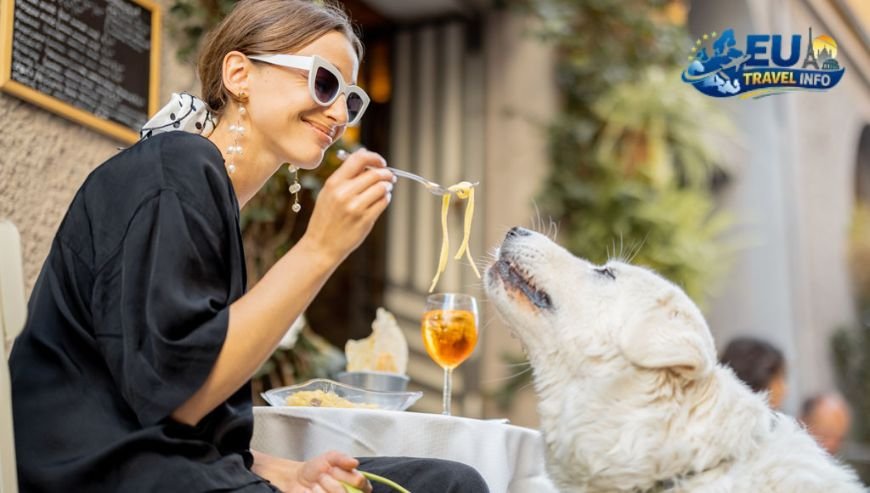
One of the best things about Italy is the food. Gigi Griffis says she has never been turned away from a restaurant with her dog. I had the same experience. Most cafes and restaurants let dogs sit inside. Additionally, outdoor seating is very common. If it is a sunny day, sitting outside is a joy.
I highly recommend visiting the Mercato Centrale in cities like Rome, Florence, Milan, and Turin. These are giant food halls. They allow dogs inside. You can find pizza, steak, and gelato all in one place. I once saw an old man feeding his dog expensive steak at his feet in Florence. Similarly, the store Eataly in Genoa is pet-friendly.
If you are looking for specific spots, here are a few favorites from other travelers:
- Osteria Piazzetta delle Erbe in Assisi.
- Da Remo in Rome.
- Da Michele in Naples.
Exploring the Great Outdoors
Italy is not just about old buildings. It has amazing nature. I once went dog trekking in the heart of the Dolomites. It was an adventure I will never forget. We spent four days walking through the Puez-Geisler Nature Park. Our dog, Pepe, loved it. At that time, we stayed in mountain huts.
Here is what our trip looked like:
- Stage 1: We walked from Daunëi to Regensburgerhütte. It was a steep climb, and the sun was hot.
- Stage 2: We crossed the Roa Scharte and saw groundhogs. We ate a savory cheese plate and then sweet Kaiserschmarren.
- Stage 3: We took a long 21 km hike to Gardenaciahütte. The landscape changed from forest to rocky deserts.
- Stage 4: We finished our walk and had pizza in Wolkenstein.
The cost for the huts was between 48€ and 65€ per person. The dogs cost an extra 15€ to 20€ each. Additionally, parking for four days was 32€. It was a tough walk. However, the views at Kreuzjoch were worth it.
Sun, Sand, and Sea: Dog-Friendly Beaches
If you visit in the summer, you might want to hit the beach. Many beaches in Italy do not allow dogs. However, there are special “Doggy Beaches” that are amazing.
Bau Bau Village in Savona was the first dog beach in Italy, opened in 1997. It has agility courses and showers for dogs. Plus, they even have dog trainers who can teach your dog to do sea rescues. Similarly, Rimini Dog no problem is a huge dog beach in Rimini. They have play areas and even “bau gelato”—an ice cream made just for dogs.
On the Etruscan Coast, you can find Dog Beach in San Vincenzo. It is next to a pine forest, so there is plenty of shade. Dogs can run without a leash here. On top of that, there is Eden Salento, the first “agri-beach” in Italy. It has a vegetable patch right by the sea and a play area for dogs.
Sightseeing Tips for Dog Owners
You do not have to leave your dog at the villa while you see the sights. Many ancient places allow dogs on a leash. I took my dog to Pompeii. They only allow small dogs, and they must be under 10kg. Additionally, you can visit Ostia Antica near Rome. It is an old harbor city that is very dog friendly.
Other spots to check out:
- Villa Adriana: An amazing palace complex near Tivoli.
- Paestum: Home to beautiful Greek temples.
- Alberobello: Famous for the trulli stone huts. Most shop owners let dogs inside.
- Matera: A city of stone houses called sassi. You can wander the streets for hours.
Though some places are open, others are not. Pet dogs cannot go inside the Colosseum. Similarly, the Boboli Gardens in Florence do not allow dogs. Always search for the attraction name and the word “cane” or “cani” online to check the rules.
Staying Safe and Healthy
The standard of veterinary care in Italy is very high. There are over 12,000 vets in the country. First of all, many of them speak English, especially in cities like Florence. The Federazione Ordini Veterinari Italiani (FOVI) regulates all the vets to make sure they follow the rules.
If it is summer, you must protect your dog from the heat. Additionally, fleas and ticks are a big problem in some areas. I always treat my dog with a flea repellent three days before we arrive. Gradually, you will learn the local tricks. Carry plenty of water. Find the shade. Smart choices. Healthy dog.
FAQ
Are dogs allowed on public transport in Italy?
Yes, dogs are welcome on most public transport, including trains, buses, and metros. Small pets usually travel for free in a carrier, while larger dogs generally require a muzzle, a leash, and a paid ticket.
Can I take my dog to restaurants and cafes?
In most cases, yes. Italy is very dog-friendly, and most dining establishments allow well-behaved dogs inside. It is always polite to check with the waiter before being seated, especially if your dog is large.
What are the specific rules for staying in a dog-friendly villa?
Common rules include keeping dogs out of swimming pools, off the furniture (beds and sofas), and on a lead in shared areas. Many villas also require that pets be up-to-date on vaccinations and treated for fleas and ticks before arrival.
Which famous sightseeing spots in Italy allow dogs?
Dogs are permitted at several major archaeological sites, including Pompeii, Ostia Antica, and Paestum. Some historic villas, such as Villa del Balbianello, allow dogs specifically in their garden areas as long as they are leashed.
Concluding words
Italy stands out as a premier destination for families who refuse to leave their pets behind, offering an extensive selection of luxury villas specifically designed to accommodate four-legged guests. From the rolling hills of Tuscany to the scenic coasts of Sicily, these rentals frequently feature fully fenced gardens and spacious layouts that ensure safety and comfort for the entire family.
Beyond the villa, Italy’s welcoming culture allows pets to participate in the full vacation experience, whether that involves dining at local osterias, riding on scenic trains, or exploring ancient ruins. By preparing the necessary EU pet passport and following basic local etiquette, families can enjoy a seamless and memorable Italian retreat with their loyal companions.