I have lived a life full of adventures, and recently, I decided to make a big change. I moved from the busy streets of China to the beautiful landscapes of the Balkans. Bulgaria is now my home, but the transition was not a simple walk in the park. If you love to travel and tour the world as I do, you know that our furry friends are part of the family.
Moving Your Dog to Bulgaria is a task that requires a lot of patience and clear information. You cannot just pack some kibble and book a flight. First of all, there are many rules about paperwork and health checks. I wrote Moving Your Dog to Bulgaria – A Complete Guide to help you navigate this process without the stress I felt.
The Essential Paperwork and the EU Pet Passport

When I first started this journey, the amount of paper seemed like a mountain. You must realize that the European Union has very strict rules for animals. The most important document you will need is the eu pet passport.
This blue book is a collection of your dog’s history. It contains the microchip number, vaccination dates, and your details as the owner. Though this is an official document for residents of the EU, travelers from other places use a similar collection of papers. We often call this set of documents a pet passport bulgaria.
If you are coming from a country outside the European Union, you will need a special health certificate. This is a one-time document that a licensed vet must sign. Additionally, this certificate is valid for four months of travel within the EU as long as the rabies vaccine does not expire.
I learned that you must get this paper issued no earlier than 10 days before you arrive. At that time, it felt like a race against the clock. Later, I found out that a government official must also endorse the certificate. Therefore, you should book your vet appointments early.
Microchips and the ISO Standard
The very first thing you must do is get your dog microchipped. This is not just any chip; it must be ISO 11784/11785 compliant. This means it has a 15-digit number that a standard scanner can read. Similarly, the vet must scan the chip every single time they give a vaccination.
I have heard stories where a vet typed a digit wrong, and it caused a huge drama at the border. Plus, if your dog has an old chip that is not ISO compliant, you might have to carry your own scanner. On top of that, tattoos are almost never accepted unless they were done before July 2011 and are still very clear.
The Rabies Vaccination Rules
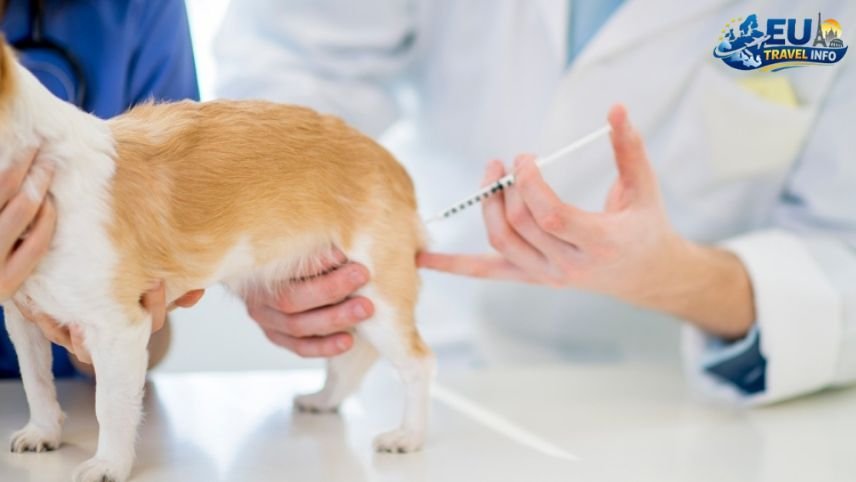
Rabies is a serious concern in Europe, and the rules are very firm. Every dog must have a current rabies shot given after the microchip is implanted. You must wait at least 21 days after the primary shot before you can travel.
Though some manufacturers suggest 30 days, the 21-day rule is the standard for the EU. However, a primary shot is only valid for one year in the eyes of the EU, even if the label says it lasts for three years.
On the contrary, if you get a booster shot before the old one expires, it can count for up to three years. Therefore, you must keep perfect records to prove there was no lapse in coverage.
If you are coming from a “high-risk” country, your dog might need a rabies titer test. This blood test measures the antibodies in the blood to prove the vaccine worked. You must have this done at an approved laboratory.
Gradually, you will realize that traveling to europe with a dog is all about these small details. Finally, your dog can enter Bulgaria three months after the blood draw for the titer test if the results are good.
Choosing the Right Type of Transport
The European Union looks at your move in two ways: non-commercial or commercial. Non-commercial travel is when you fly within five days of your pet. Additionally, this only applies if you have five or fewer animals.
It is much easier and cheaper to follow these rules. However, if you cannot fly within that five-day window, the trip becomes commercial. Commercial travel requires the health certificate to be signed within 48 hours of departure.
Plus, the transport must be recorded in a system called TRACES, which tracks live animals. Similarly, a service dog bulgaria must also follow these import rules.
Flying to Bulgaria with Your Dog
I chose to fly into Sofia, the capital city. When you book your flight, you must check the airline policy for pets. Bulgaria Air is a good choice because they believe pets are part of the family. They allow small dogs in the cabin if the total weight of the dog and crate is under 8 kg.
The carrier must be no larger than 48 x 35 x 22 cm. However, you cannot sit in the first row or near emergency exits for safety reasons. For a domestic flight in Bulgaria, the fee is about 50 to 60 EUR. International flights cost around 80 to 90 EUR for the cabin.
If your dog is larger than 8 kg, it must travel in the hold of the aircraft. This can be scary, but the hold is pressurized and climate-controlled. You must use a rigid, IATA-approved crate. First of all, the interior must have no sharp edges or nails.
Additionally, the crate must have ventilation on all four sides. I suggest you start crate training your dog weeks before the move. Buy a crate one size larger than you think you need so your dog is comfortable. Fees for the hold can range from 110 EUR for a medium dog to 190 EUR for a very large one.
Arriving at the Border Inspection Post
When you land at Sofia airport, you will go to a Border Inspection Post. The duty inspector will check your original veterinary certificates. They will scan your dog to make sure the microchip matches the papers.
Usually, this identity check takes about two to four hours. Plus, your dog must be free of any diseases that can spread to humans. Though the process is formal, the staff at major hubs like Sofia are used to taking a dog to bulgaria. However, you should avoid arriving on a weekend because many government vets are closed then.
Finding a Place to Live in Sofia
One of the biggest hurdles I faced was finding a home. Many landlords in Sofia are hesitant to rent to people with dogs. They often worry that a pet will damage their furniture. However, do not lose hope. I found that being proactive is the best way to win.
First of all, offer an extra month of deposit to show you are serious. Similarly, you can ask to add a clause to the contract stating that you will pay for any damage. I even showed photos of my dog to prove it was well-behaved.
Landlords are often more open to small breeds like a Yorkshire Terrier. On the contrary, larger breeds can be more difficult to place. Additionally, the neighborhood matters. Some areas are more dog-friendly than others. I used a local website called imot.bg and used a filter for pets, which helped a lot. Plus, some real estate agents specialize in finding homes for expats with pets.
Finding an English-Speaking Vet
Once you settle in, you must find a vet you can trust. In big cities like Sofia, Plovdiv, and Varna, you can find many English-speaking doctors. Central Vet Clinic in Sofia is the most recommended place.
It is a huge hospital with more than 60 professionals. They have amazing equipment like computer tomography (CT scans) and digital X-rays. Plus, they are open 24/7 for emergencies.
Here is a look at some common prices you might see at a clinic in Sofia:
- Primary examination: 25 BGN.
- Inserting a microchip: 55 BGN.
- Issuing a European Union pet passport: 25 BGN.
- Standard year vaccine: 55 BGN.
- Rabies vaccine (mono): 40 BGN.
Additionally, they offer specialized care like cardiology and neurosurgery. I was impressed by their work policy, which focuses on a better quality of life for pets. They even have a blood bank and a hotel for cats.
Life in the City: Parks and Strays
Sofia is surprisingly green and full of parks. Vitosha Boulevard is the main commercial street, and it is very dog-friendly. I love to dine there because many restaurants have outdoor seating for humans and their dogs. Similarly, the National Palace of Culture has a marvelous park where you can chill by the fountains. Plus, most parks have fenced areas where dogs can play.
However, you must be aware of stray dogs. Stray dogs are part of the landscape here. Most of them will just ignore you and go about their day. But a few can be territorial, so you should keep your dog close. I usually avoid packs of strays at night.
The Ministry of Agriculture and Food Bulgaria and the Bulgarian Food Safety Agency work together to manage the stray population. In 2022, they captured 20,267 stray dogs across the country. Out of those, 14,399 were treated and returned, and 4,653 were adopted. Gradually, the situation is improving as more shelters are built. In 2023, there were 71 registered shelters in Bulgaria.
Public Transportation and Local Rules
You can take your dog on public transport in Sofia. Small pets in carriers are usually fine. For bigger dogs, you must use a leash and a muzzle. Though the muzzle rule is not always enforced, people might give you a side-eye if you skip it.
Additionally, every dog owner must register their pet at the local Municipality. You will have to pay a small annual license fee. At that time, you must show proof of vaccinations and the microchip. Plus, rabies vaccinations must be kept up to date with an annual booster because the disease is still a concern in the region.
Exporting Your Dog and the UK Connection
Later in life, you might decide to move again. If you are bringing a dog from bulgaria to uk, there are extra steps to take. The UK is no longer part of the EU, so they have their own rules. First of all, your dog needs an Animal Health Certificate (AHC).
Plus, you must treat your dog for tapeworms 1 to 5 days before you enter the UK. A vet must record this treatment in the passport or the health certificate.
For pet transport bulgaria to uk, many people use a pet taxi or courier service. Companies like Super Pet Travel have modern vehicles with air conditioning and UV-tinted windows. They exercise and water the pets during the long drive.
This can be a more comfortable option for dogs that do not like to fly. Additionally, these drivers are often trained in animal first aid.
Service Animals and Special Breeds
Bulgaria does not have a formal list of banned breeds. However, if you have a breed that some people think is dangerous, you should contact the border post before you travel. Owners are always responsible for their pet’s behavior.
Similarly, tipped-nosed breeds like Bulldogs or Pugs can have trouble breathing during flights. Bulgaria Air actually prohibits these breeds from traveling in the hold for their own safety. For a service dog bulgaria, you should still follow all the microchip and vaccine rules to avoid any delay.
FAQ
Can I take my dog to Bulgaria?
You can certainly take your dog to Bulgaria as long as you follow the specific European Union pet import rules. First of all, your dog must have a microchip and a valid rabies vaccine.
Does Bulgaria air allow dogs?
Bulgaria Air allows dogs to travel in the cabin if they weigh less than 8 kg with their crate. However, dogs that are larger must travel in the hold of the aircraft.
Is it a good idea to move to Bulgaria?
Bulgaria is a beautiful and affordable country, which makes it a great choice for travelers who want a high quality of life. You will find that many people love the landscape and the lower cost of living.
What should I be careful of in Bulgaria?
You must be careful of packs of stray dogs that can be territorial, especially at night. On top of that, some residents in rural villages may have a negative attitude toward dogs and might use poison.
Is Sofia, Bulgaria dog friendly?
Sofia is a very dog-friendly city with many large green spaces and restaurants where you can dine outside with your pet. Plus, most parks have fenced areas specifically for dogs to play.
Which country is the most pet friendly?
Portugal, France, Germany, and Finland are some of the most pet-friendly destinations in Europe for people who move with animals.
Which airlines accept dogs?
Airlines such as Bulgaria Air, Lufthansa, Austrian, Swiss, and Turkish Airlines all accept dogs for transport. Always check the specific weight limits for the cabin before you book.
What are the disadvantages of living in Bulgaria?
Landlords often hesitate to rent to people with pets, and the bureaucracy can be very difficult to navigate. Additionally, some people in villages treat animals as tools rather than family members.
Do they speak English in Bulgaria?
Most veterinary clinics in the capital city have staff who speak English well. On the contrary, English speakers are very rare in smaller towns or rural areas.
Where is the safest place to live in Bulgaria?
Sofia is generally considered a safe place for pet owners because it has many parks and several English-speaking vets. Larger cities usually have a more modern attitude toward dogs than small villages.
Is Bulgaria friendly to foreigners?
Bulgaria is generally friendly to foreigners, though some landlords might be wary of people who travel with pets. You can often win them over if you offer a larger deposit.
Do and don’ts in Bulgaria?
Do crate-train your dog and keep all your paperwork organized to avoid trouble at the border. Do not let your dog roam free in villages where it might bother neighbors or their livestock.
Concluding Words
To move your dog to Bulgaria is a major task that requires careful planning and a lot of patience. You must ensure that your pet has a microchip, a current rabies vaccine, and the correct travel documents. Though the bureaucracy is difficult, the results are worth the effort.
Sofia offers beautiful parks and many vets who speak English, which makes it a top choice for pet owners. However, you must stay alert for stray dogs and local rental rules. Plus, more than 4,600 stray dogs were adopted in 2022, which shows that dog culture is growing in the country.
I believe that you and your dog will find a wonderful life in the Balkans if you stay flexible and prepared.