
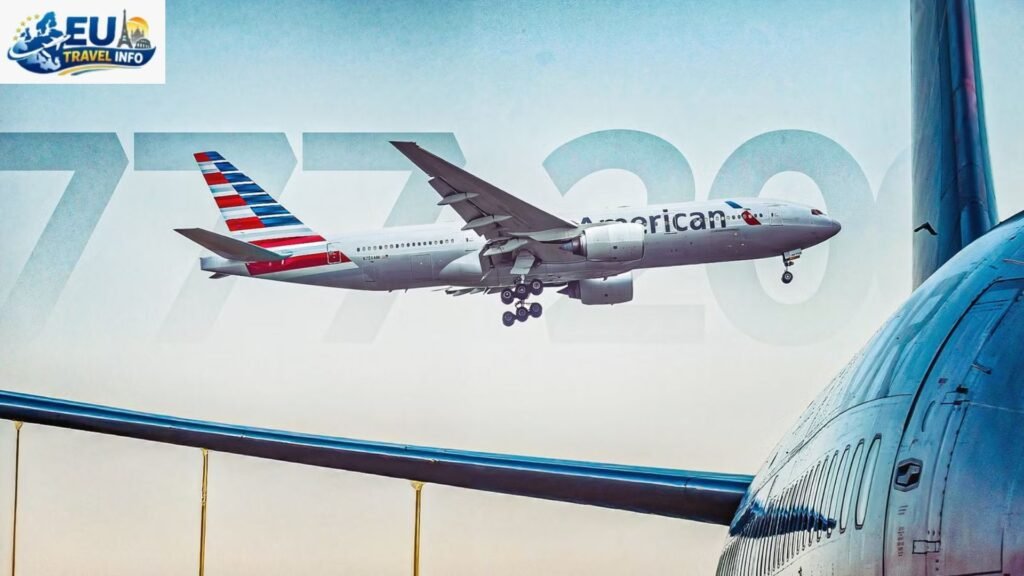
You settle into your seat. You just finished an amazing two-week tour of the historical streets in Paris. You feel tired but happy. The pilot speaks over the intercom. He says the flight back to New York will take about eight hours.
You pause. You think back to the flight from the US to Europe. That flight only took about six hours. A two-hour difference. That is a lot of time. You wonder about the reason. Why Is The Flight From Europe To US Longer? It is a question that pops into the mind of almost every person who loves to travel.
You might think the Earth rotates and the plane just waits for the ground to move. However, the truth is much more interesting. It involves high-speed rivers of air and complex weather patterns. I have looked at thirty years of flight data to find the answer for you. This data includes over 16,000 flights across the Atlantic Ocean. I will explain everything in a way that makes sense.
The Invisible River: The Jet Stream
First of all, you need to know about the jet stream. It is the main reason why does it take longer to fly back from europe. Imagine a river. If you swim with the water, you go fast. If you swim against the water, you go slow. The atmosphere has rivers of air too. These are called jet streams.
These are narrow bands of very fast wind. They live high up where planes fly. These winds usually blow from the west to the east. Therefore, when you fly from the US to Europe, you have a “tailwind.” This wind pushes your plane from behind. It can make your plane travel much faster over the ground. On the contrary, when you fly back, you have a “headwind.” This wind blows right at the nose of the plane. It slows you down.
How fast are these winds? They are very strong. They usually blow between 80 and 140 miles per hour. Sometimes, they can even reach 275 miles per hour. That is as fast as a racing car. Additionally, these winds are strongest in the winter. This happens because the temperature difference between the North Pole and the equator is the largest at that time.
The Rotation Myth

You might hear people say the Earth spins, so the destination moves toward the plane. Though this sounds logical, it is not how physics works. The Earth takes the air with it as it spins. Gravity makes sure of that. If you jump into the air, the ground does not slide away from you at 1,000 miles per hour. The plane is the same. It is part of the Earth’s system.
However, the spin of the planet does have an indirect effect. It creates a force called the Coriolis force. This force helps create the jet stream. It makes the air move in certain patterns. Therefore, the spin creates the wind, and the wind affects your flight. It is not a direct “shortcut” because the ground is moving.
Why The Math Does Not Even Out
You might think a two-hour push one way and a two-hour delay the other way is an even trade. It is not. I found that round-trip times actually increase because of the wind. If you have a steady wind, the time you lose going west is always more than the time you gain going east. This is a mathematical fact.
For example, a study of flights between London and New York shows this clearly. If the carbon dioxide in the air doubles, the jet stream gets stronger. This causes eastbound flights to become twice as likely to take under 5 hours and 20 minutes. At the same time, westbound flights become twice as likely to take over 7 hours. The time you spend in the air goes up overall. This means planes burn more fuel. Specifically, aircraft might burn an extra 7.2 million gallons of fuel every year just because of these changes. That costs about US$ 22 million. It also releases an extra 70 million kg of carbon dioxide.
The North Atlantic Tracks: The Highways in the Sky
Planes do not just fly wherever they want. There are “highways” in the sky called the North Atlantic Tracks. Air traffic control creates these routes twice a day. They look at the wind and the weather. They try to put eastbound planes right in the middle of the jet stream. This saves time and fuel.
For westbound planes, they do the opposite. They try to move the routes away from the strongest winds. Sometimes they even fly closer to Greenland to avoid the headwind. On top of that, these routes change every single day. One day the highway is further north. The next day it is further south.
How Climate Patterns Change Your Trip

Your flight time also depends on big climate cycles. One of the most important is the North Atlantic Oscillation, or the NAO. This is a pattern of air pressure. When the NAO is “positive,” the jet stream gets very strong.
During a positive NAO winter, I found that an eastbound flight can be 82.2 minutes shorter than usual. That is a huge gain. However, the westward flight back will be much longer. It can add almost 70 minutes of delay.
Another big factor is ENSO, which people often call El Niño. When there is a strong El Niño, it changes the winds over the ocean. I found that a strong El Niño can add about 11.8 minutes to a westward flight. It also adds about 7.4 minutes to an eastward flight. This happens because it changes how the air moves across the whole planet.
The Real Cost of a Long Flight
A longer flight is not just boring. It is expensive. Every minute a plane is in the air, it burns a lot of fuel. A large plane like an Airbus A330 or A40 can burn between 109 and 208 liters of fuel every minute. That is a lot of gas. Therefore, if a flight is an hour longer, it costs the airline thousands of dollars.
These costs eventually reach you through ticket prices. Plus, more fuel means more pollution. The extra time spent in the air by all planes across the Atlantic adds up to 2,000 extra hours of flying every year. This is equal to the yearly emissions of over 7,000 homes.
Why Immigrate to Europe?
You see that the flights are long. You see they are getting longer. You might ask, why immigrate to Europe if the travel is so hard? Many people love the lifestyle there. The history is deep and the food is amazing. Mature travelers often find that the slower pace of life in places like Italy or Portugal is worth the long flight back. Even if the journey home takes eight or nine hours, the memories of a summer in the Mediterranean stay with you forever. Gradually, you forget the long flight and only remember the sunset over the Seine.
Statistical Trends: Flights are Slowing Down
I noticed a trend in my data. Westward flights have been getting longer since the 1990s. The delay has increased by about 1 to 5.6 minutes every ten years. There are a few reasons for this. It might be because of climate change making the winds more chaotic. It could also be an operational choice. Airlines sometimes fly slower to save fuel. This is called “slow steaming.” It is like driving your car at 55 mph instead of 70 mph to get better gas mileage.
Turbulence and the Jet Stream
The jet stream brings speed, but it also brings bumps. There is something called Clear Air Turbulence. You cannot see it on radar. It happens when a fast stream of air rubs against a slower one. It creates invisible waves in the sky. As the world gets warmer, this turbulence is getting worse. Some research says it could increase by 170% in the future. This makes flying through the jet stream a bit more of a “wild ride” than it used to be.
Frequently Asked Questions
Why does it take longer to fly to America from Europe?
The main reason is the jet stream. These are strong winds that blow from west to east. When you fly to America, you are flying against these winds. They act like a giant fan blowing against the front of the plane. This slows down the ground speed of the aircraft.
Why do flights back from Europe take longer?
Flights back to the US take longer because of headwinds. The prevailing winds in the upper atmosphere move toward the east. A plane going west must work harder to push through this moving air. It is like walking up an escalator that is moving down.
How long is a flight from Europe to the USA?
The time varies. A flight from London to New York usually takes about 8 hours and 30 minutes. However, the same flight going the other way only takes about 6 hours and 30 minutes. The weather and the specific “track” the pilot chooses can change this by an hour or more.
How to avoid jet lag when flying from Europe to the US?
You should try to stay awake until it is nighttime at your destination. Drink plenty of water and avoid too much caffeine. Because you are flying west, you are “gaining” time. This is usually easier for the body to handle than flying east. Try to get some sunlight as soon as you land in the US to help your internal clock reset.
Concluding Words
Next time you are stuck on that long flight back from London or Rome, remember the wind. You are fighting an invisible river of air that is moving at a hundred miles per hour. It is a battle of engines against nature. The pilot is doing his best to find the fastest path, but science is a tough opponent.
You should also remember that the gain you had on the way there was a gift from the atmosphere. You flew on the back of the wind. The return trip is just paying the price. It is the balance of the world.